
A Flying Car Company Survives, and I Wonder Where the Value Went
Winning a Minister’s Award, and a Type Certification Target That Keeps Slipping
The other day I saw news that SkyDrive, a company developing flying cars, had received the Minister of Land, Infrastructure, Transport and Tourism Award at the Japan Startup Awards 2026. The ceremony was held at the Prime Minister’s Office, and the Prime Minister reportedly tried a flight simulator at the booth. According to the announcement, mass production is being set up at a Suzuki Group plant, stable flight at 100 km/h was confirmed in June 2026, and the company is targeting service launch in 2028.
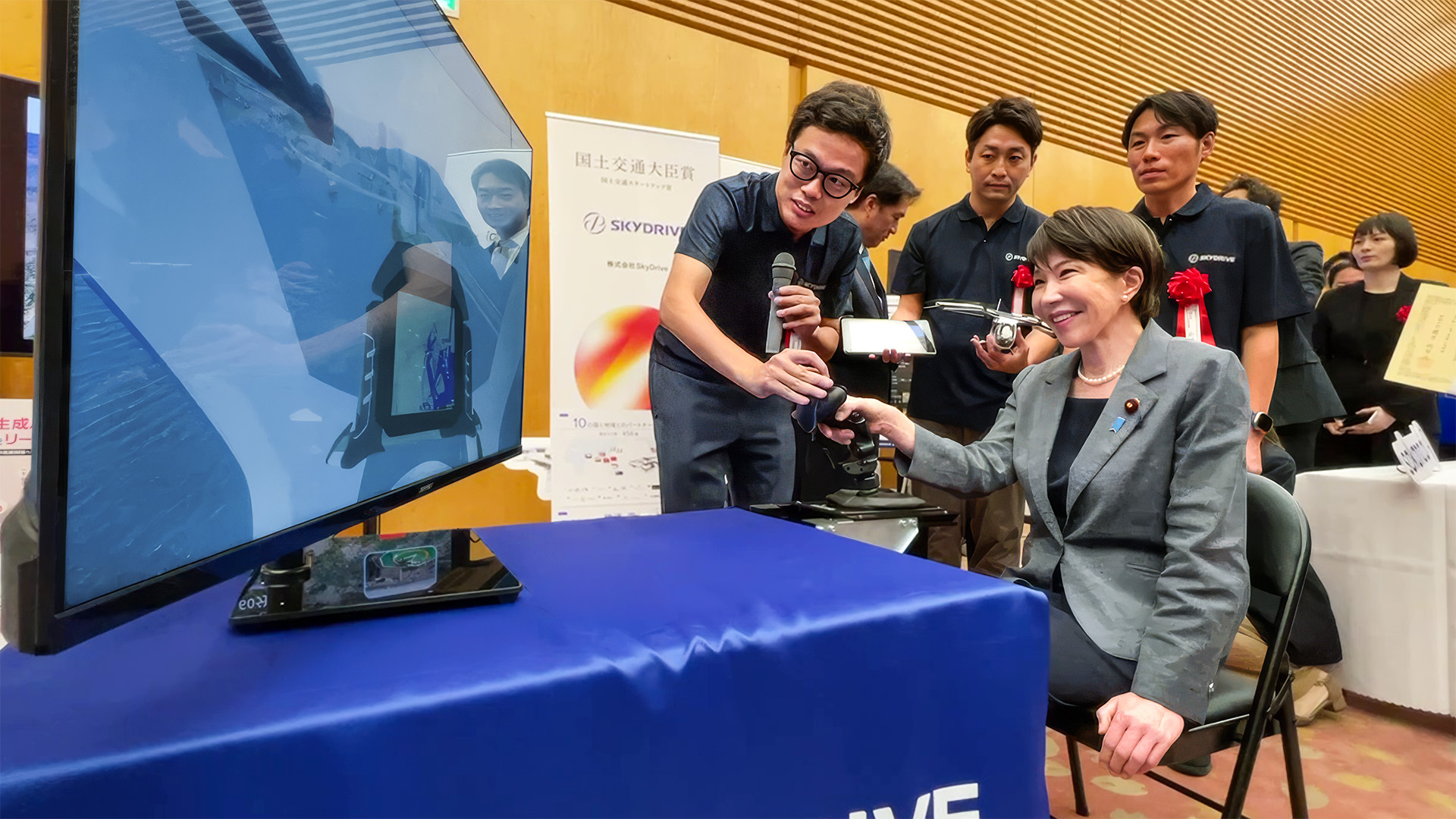 SkyDrive: Receives “Minister of Land, Infrastructure, Transport and Tourism Award” at Japan Startup Awards 2026skydrive.co.jp
Type certification, though, is still pending. As of 2025, the company was aiming to acquire type certification as early as 2026, so the target date has been slipping back little by little.
Lilium Raised €1.5 Billion and Still Disappeared
This news reminded me of something that happened in Europe a while back.
Germany’s Lilium raised roughly €1.5 billion in total from investors and listed on the US Nasdaq, making it one of the flagship companies in the flying car field. Then, in the fall of 2024, it filed for insolvency once, failed to put together a rescue deal, and filed for insolvency a second time in February 2025, halting operations. Germany’s Volocopter also entered insolvency proceedings in December 2024, and its assets ultimately went for about €10 million to Diamond Aircraft, a subsidiary of China’s Wanfeng Group.
 AVweb: Lilium Files for Insolvency a Second Time, Heading Toward Shutdown (February 2025)avweb.com
 AIN: Diamond Aircraft Absorbs Volocopter (March 2025)www.ainonline.com
SkyDrive, meanwhile, announced cumulative funding of over $2.8 million (¥43 billion)… wait, let me check that figure — as of July 2025 the company announced cumulative fundraising of over ¥43 billion.
However you convert the currencies, that is probably only a fraction of what Lilium raised.
The company that raised more money disappeared. The one that raised less survived.
I couldn’t immediately explain where this difference came from, or what it means for the one that survived.
The Difference Can’t Be Explained by Technology
The first thing that occurred to me was a difference in technology. Lilium’s aircraft had a fairly ambitious configuration, embedding a total of 36 electric ducted fans in the movable flaps of its wing and canard, changing the direction of the fans flap by flap to transition from vertical takeoff to horizontal flight. Lilium itself explained that hovering required about twice the power of an open-rotor aircraft in the same class, and that the design philosophy was to make up for that with cruise efficiency. In the end, it never reached manned flight.
 eVTOL.news: Lilium’s Technology Approach Explained (36 ducted fans and an “electric jet engine”)evtol.news
The explanation that it reached too far technologically is easy to accept. But that doesn’t explain Volocopter. Volocopter’s aircraft had a comparatively simple configuration with many rotors arranged in parallel, had a track record of manned flight, and was proceeding toward type certification from the European Union Aviation Safety Agency (EASA) in 2025. If anything, it was on the more solid side technically, yet it ran out of money all the same. The technology gap alone doesn’t explain it.
SkyDrive Has Effectively Become a National Policy Company
The next thing that occurred to me was a difference in government backing. But Lilium, too, had been negotiating with the Bavarian state government and others for a €50 million loan guarantee. In the end that deal didn’t come together, but it’s not as though they hadn’t been talking with the government.
Japan’s backing, though, is quite different in both scale and depth. A public-private council on flying cars has been active since 2018, the Osaka-Kansai Expo provided a venue for demonstration flights, and in February 2025 the Japan Civil Aviation Bureau, under the Ministry of Land, Infrastructure, Transport and Tourism, issued airworthiness criteria specific to SkyDrive’s aircraft for type certification. Add this latest award to the pile, and it’s fair to say SkyDrive has effectively become the company representing national policy in this field.
Behind the Companies That Survived, There Is a Company With a Factory
Still, this only explains half of why the company survived. Even with government backing, if the money to build the aircraft runs out, the business stops. So when I lined up the companies that survived, another common thread appeared.
Behind them is a company that owns a factory.
Under its business and technology partnership agreement with Suzuki, SkyDrive has been manufacturing its aircraft since 2024 at a Suzuki Group plant in Iwata City, Shizuoka Prefecture. The setup reportedly allows for production of up to 100 units a year. Joby Aviation, which is in the final stages of type certification in the United States, has received investment from Toyota and is also partnering with it on production. Volocopter ran out of money once, but the business itself continues, having been absorbed by the aircraft manufacturer Diamond Aircraft.
Lilium’s first insolvency filing, by contrast, is reported to have been due to a lack of funds to stand up mass production.
Seen this way, the conclusion feels fairly natural. In aircraft development, the part that costs the most money isn’t flying a prototype — it’s building the mass production and quality assurance system that comes after. Factories, equipment, quality control systems, and the people to run them all have to be in place before any revenue comes in. Money raised from venture capital or from a listing via a SPAC (special purpose acquisition company) is, in essence, money paid against expectations of future growth, which makes it hard to secure additional funding at exactly this heaviest, costliest stage. For an operating company that already has a factory, lending out its own lines, people, and quality control systems ends up being far cheaper than building a factory from scratch.
The list of SkyDrive’s shareholders bears this out. In its July 2025 funding round, 11 companies took part, including MUFG Bank as one of the lead investors, along with Suzuki, JR East, and JR Kyushu. JR East is reportedly considering a flying car mobility service in Iwate, and JR Kyushu is considering one in Oita.
What Do the Companies Providing Support Receive in Return?
So, at this point, the reason for survival is clear. The company has become a matter of national policy, and large companies around it are propping it up. It won’t easily collapse.
The question is what comes after that.
The companies providing support aren’t doing it out of charity. A company that takes on manufacturing receives payment for manufacturing every time an aircraft is built. A railway company considering operations gets something in return by folding the service into its own rail lines or tourism business. A bank earns interest on what it lends. These are all legitimate transactions based on contracts.
The value of the startup’s own shares, on the other hand, is ultimately determined by how much it is worth when it goes public or gets acquired. In startup fundraising, preferred shares — which get priority payout in the event of a sale or liquidation — are generally used. For a company that has taken in over $2.8 million…
Actually — for a company that has taken in over $271 million in cumulative funding, for there to be a meaningful amount left for the founders and common shareholders, the company needs to go public or be sold at a valuation well above that figure.
In other words, a truly spectacular IPO would reward the company as a startup. Short of that, the fruits of its development work will, in the end, be rightfully carried off by the companies that supported it, in the form of manufacturing contracts, business integration, and priority payouts.
No one is doing anything wrong here. Value is simply flowing according to the contracts.
The More a Business Becomes National Policy, the Thicker the Supporting Companies’ Share Gets
I think the fact that this has become a matter of national policy actually reinforces this structure. A business the government is backing cannot easily be allowed to fail visibly. So when funds run short, the surrounding companies step in to support it again. And the more they support it, the thicker the share those companies receive becomes. Being hard to kill and being rewarded as a startup turn out, at this point, to be two separate things.
Who You Raise Money From Also Decides Where the Value Ends Up
So, here is my answer. What determined whether a company in this industry survived was not how much money it raised, but who it raised that money from. And who it raised money from also determines, at the same time, who ultimately ends up owning the value that remains.
Given my line of work, I hear a lot of stories from hardware startups, and when the conversation turns to fundraising, the talk inevitably jumps straight to the amount raised or the valuation. But in a hardware business where mass production is unavoidable, I think it’s worth thinking through, at the stage of choosing investors, both what that company will do for you at the mass production stage and what it will take in return. The support that keeps you alive and the destination of the value you create are decided simultaneously, within the same contract.
References
- SkyDrive, “Receives ‘Minister of Land, Infrastructure, Transport and Tourism Award’ at Japan Startup Awards 2026”
- Ministry of Land, Infrastructure, Transport and Tourism, “Recipients of the MLIT Startup Award at ‘Japan Startup Awards 2026’ Decided”
- Norimono News, “‘Railways + Flying Cars’ as a New Form of Travel!? JR East and JR Kyushu Newly Join, SkyDrive Raises $52 million”
- Impress Watch, “SkyDrive Raises $52 million from 11 Companies Including JR East and JR Kyushu”
- eVTOL.news, “Lilium’s Technology Approach Explained”
- AVweb, “Lilium Likely Permanently Closed”
- ch-aviation (On Lilium’s insolvency process and the Bavarian loan guarantee)
- DER AKTIONÄR (dpa-AFX), “Lilium meldet zum zweiten Mal Insolvenz an”
- AIN, “Wanfeng’s Diamond Aircraft Absorbs eVTOL Developer Volocopter”
- AIN, “China’s Wanfeng Group Set to Buy eVTOL Developer Volocopter for €10 Million”
- Automotive World, “Joby nears FAA certification as manufacturing ramps up”
This piece was conceived and directed by Yuichiro Kuzuryu, with the writing done by AI.
Originally published in Japanese at https://clazytech.com/2026/10/1854/. Translated with LLM assistance and reviewed before publication.