Japan Stuns Spain 2-1 To Reach World Cup Knockout Stage
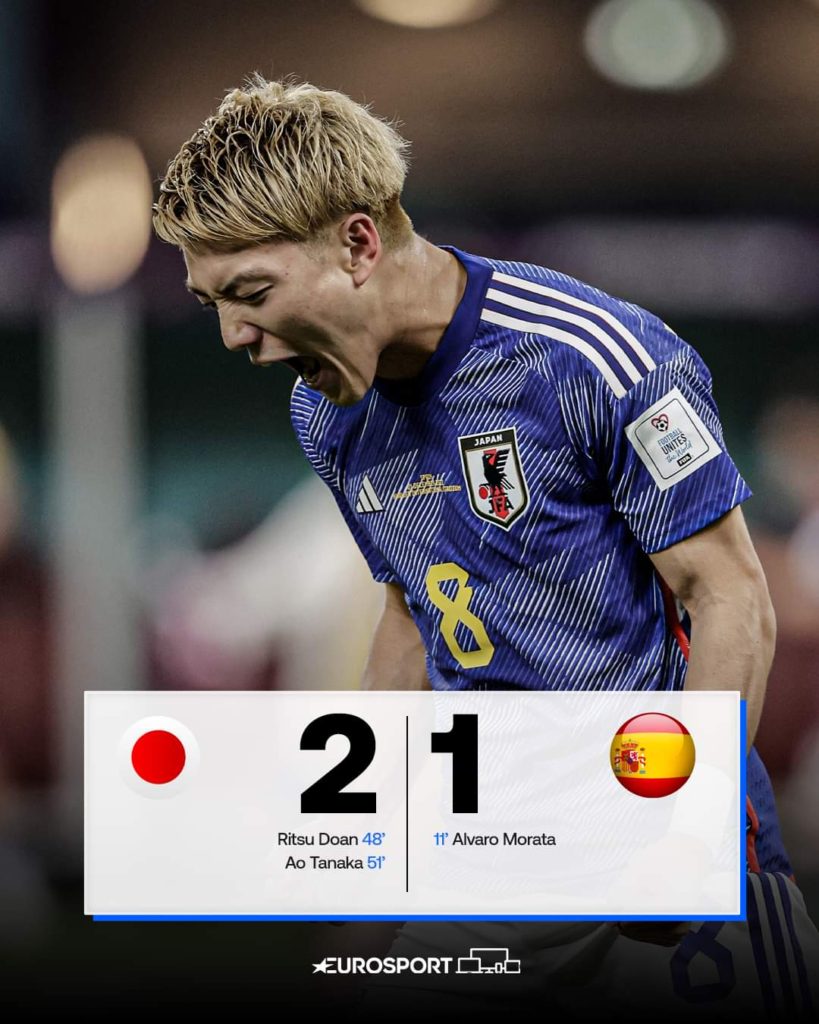
Japan came from behind to beat Spain 2-1 in the final group-stage match of the Qatar World Cup.
Excitement, surprise, relief. It’s a mix of complicated feelings, but first I simply want to celebrate advancing to the knockout stage. And I’d like to take a moment (in my head, for now) to imagine how this World Cup will be remembered in the future history of Japanese football.
<A match where it’s hard to say who the key man was>
My first honest thought after the match was how genuinely hard it was to say “well, today’s key man was so-and-so.”
If I had to name one, it would be manager Moriyasu. (Then again, the manager is inevitably a key man in every match anyway.)
Put simply, there were a lot of key men. Really, everyone was.
We spectators need to start learning how to watch these matches too. Manager Moriyasu isn’t approaching this as a 90-minute match, but as two 45-minute matches. That was true against Germany, and it was true against Costa Rica as well.
The 45-minute split happens to coincide with halftime, but either way, he isn’t thinking in terms of “dominate the opponent for 90 minutes” or “defend well for the full 90 minutes.” He seems to design it as: the first 45 minutes is this kind of match, the second 45 minutes is that kind of match.
Seen that way, Nagatomo — who spent the first half simply marking Nico Williams, unable to keep possession at all, and left with a somewhat sour impression — could be said to have faithfully completed his mission in a certain sense. He was probably giving up on attacking down the left in the first half.
Kubo, too, looked considerably less stiff than against Germany and showed some good play, but he wasn’t involved in any decisive chances. Still, understood as part of the game plan, he can be seen as having faithfully carried out his role.
<First half>
The start. The back three from kickoff was a formation designed with an awareness of the height of Spain’s wide players, but the defense-to-attack concept remained consistent throughout.
Still, the low position of the press bothered me.
For one thing, Maeda at the very front pressed Busquets in an oddly fixated way, which meant the passing lanes weren’t sufficiently restricted — Spain’s defensive line must have found that quite comfortable. It might have been worth opening up the lane to Busquets and instead aiming to win the ball there, but Japan probably judged that there was no need even to try it, since they’d surely be punished for it.
In any case, once it became clear the ball couldn’t be fed to Busquets from the defensive line, what did Spain do? Pedri dropped deep. By taking up that deeper position, he completely neutralized the press.
This was probably a decision made at the individual level, but it was such a precise piece of positioning that only someone watching closely on TV could really appreciate it.
When Pedri drops next to Busquets, or even close to the defensive line, a blank space opens up there. In principle, Tanaka or Morita — the defensive midfielders — should go to fill that space, but in the first half there was considerable confusion here.
The reason was the back three.
Japan played a back three, and Spain’s front line was a front three. But Williams and Olmo are both good at drifting wide. That meant the wing-backs, Nagatomo and Ito, ended up effectively forming a back five to cover the two of them, leaving two of the three center-backs without a marker. So one takes Gavi, and the other is left free. That much is straightforward. That should allow one of the defensive midfielders to push forward.
Easy to say in words, but this coordination was extremely difficult in practice. Morata isn’t the type to drift wide, so he’s easy to account for, but Gavi moves everywhere. Williams tends to stay wide, but Olmo comes into positions almost like a second striker. The handoff of these markers didn’t go well, and a large blank space opened up in front of the defensive midfielders as a result, one that Spain exploited effectively.
Also, unless the defensive midfielders push forward and create a point to win the ball, the counterattack after a turnover loses much of its effect. Not enough numbers, no space, and a starting position too deep.
So the ball basically got surrounded and lost almost immediately. That, in essence, was the picture.
By around the 30th minute of the first half, Japan had finally managed to adjust on this point, but conceding a goal amid this confusion was extremely costly.
Even so, at 0-1 the flow wasn’t especially bad — though honestly, there was no sense at all that Spain looked beatable. It was with that kind of atmosphere that the teams went into the second half.
And as it turned out, that worked in Japan’s favor.
<Second half>
The start of the second half. Spain came out still in the relaxed rhythm of the first half, while Japan pressed as if they were a different team.
Pressing in the opponent’s half, Ito forced a trapping error from Spain, and the loose ball fell to Doan, who struck from a middle-range angle on the left. A shot from the angle he has scored from repeatedly in the Bundesliga naturally worked against Unai Simón too. A superb goal to equalize.
Spain was clearly lacking concentration. Maybe news of the Germany-Costa Rica score had come in at halftime; maybe they’d grown complacent, thinking the game would end easily given how toothless Japan’s attack had looked.
In any case, it was Tanaka’s positioning, shrewdly exploiting that looseness, that pushed considerably higher up the pitch. Tanaka lays it off to the right, Doan crosses, Mitoma cuts it back, and there’s Tanaka — for a defensive midfielder to arrive in that position in front of goal, in a match where Japan had been pinned back so heavily in the first half, takes real conviction.
There was probably a clear instruction behind it.
Japan then weathered Spain’s ferocious onslaught that followed and held on to win.
Let me lay out a few key points below.
<Pedri falls silent>
Some way into the second half, I noticed a clear discomfort in the overall balance. Pedri’s positioning had become more advanced. This continued until around the 20th minute of the second half, for a while even after Japan took the lead.
As a result, the blank space that had troubled Japan in the first half instead turned into a “hunting ground” for Japan’s press. Every one of Japan’s goals was triggered by pressing from the front line, and Pedri, in fact, had a major hand in that.
I’ve rarely seen Pedri’s positioning be wrong, so I suspect this came from the manager. Spain’s front line is thin (essentially just Morata), so I understand the desire to add some thickness there. But that doesn’t look like the strategy a Spain side “content to lead or even draw” should have taken.
Luis Enrique’s misjudgment gave Japan a major opportunity.
<The assumption that Busquets wouldn’t shoot from range>
Late in the second half, Japan set up a solid block in front of their own goal. They could do this so decisively because of Busquets. In fact, Japan barely pressed Busquets at all. Their positioning almost seemed to say, “go ahead and shoot from distance if you want.” Instead, they concentrated their preparation on pressing whoever received the ball after Busquets. When you set up a solid defensive block, the last thing you want to face is a shot from midrange. If it’s on target, there’s a reasonable chance of a goal through a deflection or a goalkeeping error. So you’re normally forced into active defending out of fear of that shot.
And yet Japan didn’t press Busquets at all — whether as the fruit of scouting or some other deliberate calculation.
Given how heavily Maeda had been deployed in the first half specifically to deny Busquets the ball, this looks strange. It could be read as fixing the first-half problem, or as a deliberate plan: tighten the block centrally, win the ball out wide, and let Busquets have it instead.
<Tomiyasu shining quietly>
Tomiyasu, brought on in the 69th minute, was clearly a message to the team: let’s see this out. At the same moment, Spain brought on Ansu Fati in place of Gavi — Barcelona’s formidable attacker. This substitution, aimed squarely at pitting Tomiyasu against Fati, was spot on.
Did they read it? Or was it coincidence?
Tomiyasu neutralized Fati — it’s fair to say he shut him down completely, let him do nothing at all. It’s almost too good to find words for. As he’s already shown repeatedly this season at Arsenal, when made to fight in a wide, confined area, there’s barely an attacker who can get past Tomiyasu, even at the very highest level of the world game. Arteta always throws Tomiyasu at the wide attacker he wants to erase from the game, and it works enormously well. Arteta pioneered this, and Moriyasu seems to have learned that lesson precisely.
<Spain’s defensive line in the closing stages>
Deep in the closing stages of the match, something was clearly at work on the Spanish bench — a certain judgment. Even if they hadn’t been getting updates on the Germany-Costa Rica score continuously, they surely had by this point, and had passed the news to the players as well. Asensio up front was shouting somewhat heatedly to rally the team, yet Spain’s defensive line never pushed up until the very end. They were never a team built around power play to begin with, but even so, the full-backs should have been taking up much higher positions. Carvajal in particular, who came on partway through, probably never once overlapped past midfield. That’s hard to imagine from the full-back of a team that’s losing.
In other words, a judgment of “this is fine as it is” looks to have been at work to some degree.
Naturally there’s the pride of a World Cup-winning nation at stake, and it’s hard to imagine the public would approve of a team that doesn’t attack. Still, I think that judgment was working softly, in the background.
Various media outlets had “predicted” this possibility, but personally I saw it as something that could happen depending on how the closing stages unfolded, not something Spain would deliberately aim for.
So what’s most remarkable, above all, is that it was Japan who created that situation.
<The tears of Yoshida and Itakura>
There must have been tremendous pressure.
The defense was, without question, what left the deepest sense of inadequacy after the Costa Rica match.
Being held to a scoreless draw by a deeply defensive opponent happens reasonably often in the world. It’s no different at the World Cup.
So the very worst thing that could happen is losing to a deeply defensive opponent after conceding a goal from a careless mistake — a pattern that happens maybe once in several dozen matches, and it’s exactly what happened.
Thoughts of “why didn’t we do this” and “if only we’d done that there” must have run through their heads over and over. But simply resetting and facing the next match thinking there’s another game, we can win the next one, takes tremendous mental strength.
That strength broke with the victory, and the tears came. What a wonderful thing it is to cry tears of victory.
There’s no need to cry again even if they beat Croatia in the next match.
People call a miracle that happens twice inevitability.
There’s no more surprise left.
There is only joy.
Originally published in Japanese at https://clazytech.com/2022/12/1536/. Translated with LLM assistance and reviewed before publication.