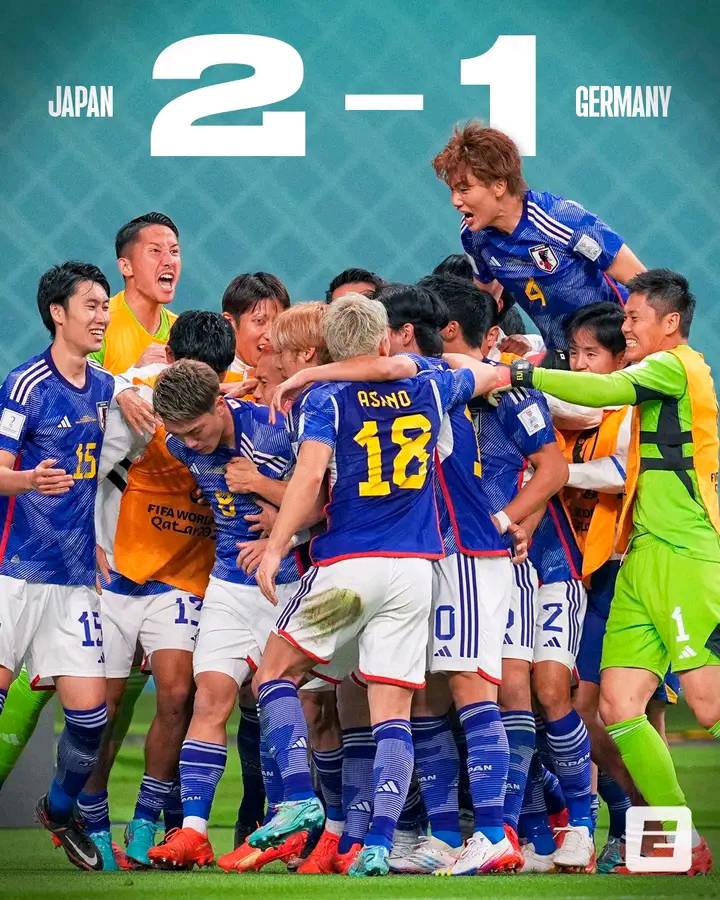
Japan's Win Over Germany Shows What Attacking Courage Can Do
Japan beat Germany in their opening game of the 2022 Qatar World Cup.
This doesn’t happen very often, so I want to write down my honest thoughts while they’re fresh.
I hope I can look back on this fondly someday.
Iran and Saudi Arabia
First, I shouldn’t forget the two contrasting matches that came before this one.
Iran lost badly to England, 2-6.
Saudi Arabia, on the other hand, came from behind to beat Argentina 2-1.
What made the decisive difference between the two?
Anyone who watched the games knows: an attacking mindset.
Iran respected England and sat deep from the very start.
There was almost no chasing from the front line. The wide players dropped deep too, shoring up the center.
Iran’s intention to play for a draw was obvious from the opening whistle.
But England had enough technique and speed to pick that apart easily.
Bellingham, who scored the opening goal, plays in midfield, the third line, yet in the end it was the wide areas that got broken down and became the starting point.
Iran kept sitting deep after that, trying to concede as few goals as possible. The result was a heavy defeat.
You could say the result matched their true ability, and leave it there, but
any Iran fan must have thought: why choose a game plan that could only ever produce a result matching your true ability?
Saudi Arabia did something different.
Against an Argentina side vastly superior in technique, they came out with a high line.
A high line. Not a high press.
Call it somewhat outdated as tactics go.
A high line carries huge risk.
It demands the goalkeeper push up too, and organizing the defensive line becomes extremely difficult.
On top of that, one misjudged passing lane in midfield and you concede immediately.
A high line often struggles against opponents who attack mainly through the wide areas, and covering the flanks to compensate tends to leave you in something like a back five, exposing deep central midfield areas.
Saudi Arabia’s midfield defending was in fact far from perfect, and they were cut open by through balls many times.
But they held on.
Their fullbacks rarely lost their individual battles, and their center-backs defended with tremendous intensity.
They couldn’t commit numbers in the scoring scenes, and luck played its part too, but
in the end Saudi Arabia chose a simple wager:
do what we want to do, and if we lose 0-4 or 0-5, so be it — go for the win even against long odds.
That courage, and the decisiveness and unity behind that decision, deserve credit.
Now, what about Japan?
Everyone must have felt that Japan changed completely between the first half and the second half.
The first half played like Iran. The second half, in a certain sense, looked like Saudi Arabia.
The confusion of the first half
Among Germany’s key players, the one who obviously stood out was Raum on the left, who won the penalty.
He took up a very high position, banking on Japan sitting defensively.
He isn’t a player who cuts inside, so in theory Japan should have found him easy to deal with. They struggled anyway.
Why? Because Japan’s holding midfielders kept getting their balance disrupted.
And who created the trigger for that disruption? Germany’s three central midfielders.
Müller, Musiala, and Kimmich.
They drifted to the flanks to create a numerical advantage, then opened horizontal or vertical passing lanes from there.
To shut that down, Japan’s holding midfielders shifted over,
which opened up the inside channel,
which pulled the fullback inward,
which left Raum free out wide.
That was exactly, precisely, what Germany intended.
Watching the first half, many people probably wondered why Germany’s passing was getting through so easily.
Germany’s midfield passing is world class, of course. It’s not something you stop that easily.
But Japan’s midfield defensive ability isn’t low either.
Endo would prove that again and again in the second half.
The cause wasn’t a lack of pressure out wide — the restriction from the front line, before that, was too loose.
Maeda, Ito, and Kubo up top weren’t forcing the opponent to carry the ball to the place Japan intended, at the timing Japan intended.
Without that, the defense inevitably reacts late, because the pitch is fairly wide.
Teams with a fast press aren’t necessarily teams with fast legs.
It’s that they restrict the opponent properly from the front line and force the kick or the dribble toward a predetermined spot.
That was Japan’s ideal too, naturally.
But they couldn’t manage it. That happens.
On this point, unfortunately, it came down to a gap in ability.
The transformation of the second half
So how did Japan change in the second half?
Put simply: they stopped trying to force the opponent into their intended traps.
Honestly, I think this was a major decision.
They took the gap in ability seriously and chose to change their own approach to match the opponent’s.
Specifically, they switched to a back three leaning toward a back five, which made the marking assignments against Germany’s front players much clearer.
Raum and Nyabri aren’t players who move around all that fluidly, so “just contain the man in front of you” was enough to lighten the wingbacks’ decision-making burden.
The center players still moved fluidly, but once the wingbacks no longer had to worry about the flanks, their decisions got lighter too.
A lighter decision-making load speeds up the press directly, because there’s no hesitation.
Japan judged that this would let them compete on even terms.
In other words, they judged that while they were inferior in individual technique and overall team quality, they weren’t necessarily losing when it came to intensity in individual moments.
I think this is actually a groundbreaking realization.
Japan has never been blessed with physique, racially speaking, and the Japanese stereotype has always been high agility, low intensity.
That perception was overturned here. The central figure in that, of course, was Endo.
In the second half, Germany could no longer thread passes into the center as easily as before.
That’s because Japan’s holding midfielders were defending tightly.
Had Japan lost the ball there, it would undoubtedly have been dangerous even against Germany.
(The scene where Maeda had his goal disallowed for offside in the first half is a typical example of this.)
Japan’s front line is picked for speed, so they carry more than enough destructive power on the counter.
Asano especially, who scored the winning goal, fires away without much thought whenever there’s even the slightest gap, even without a clear shooting angle.
This is exactly the type of player defenders hate most.
A slightly reckless guy who shoots anyway even when his lane is supposedly cut off.
There was a scene where Rüdiger provoked Asano.
I don’t think that was mockery — I think he wanted to assert psychological dominance.
I’m not going to lose to you.
In other words, Asano annoyed him. (There was a lot of adrenaline flowing.)
You don’t provoke someone beneath your notice.
Japan’s approach in the second half had a good clarity to it.
Defensively, it was mostly a solid plan built around fixed marking.
In attack, it was the front three plus just one of the two wingbacks.
Trap them with the holding midfielders, then counter from there.
After the confusion of the first half, Japan managed an extremely clear switch.
This was undoubtedly one of the factors behind the win, and it makes you realize how unusual a Japan capable of this really is.
Changing the game plan
Changing the game plan mid-match is common enough. So are unexpected substitutions.
But most of the time, all that produces is something along the lines of: well, the substitute scored, didn’t he.
Are there really many teams that made a change this big between halves and had it work this well?
Against Germany, no less. In their opening World Cup match, no less.
When the starting lineup was announced, the first thing I thought about was who they were planning to substitute.
The swaps of Maeda and Asano were easy to predict, and it was immediately clear Nagatomo wasn’t playing the full match.
Aoi Tanaka’s condition didn’t look perfect either, so I didn’t expect him to go the distance,
and I figured there would be substitutions for Kubo and Mitoma too.
Had Japan fallen behind, they could have brought on Doan or Minamino for Tanaka and dropped Kamada into a holding midfield role.
That accounts for four slots, plus maybe one more for an injury or some other trouble.
What struck me at this point was just how flexible the positional structure was.
Players besides Asano could come in as the lone striker.
Minamino and Kamada aren’t without experience there either.
Kubo and Junya Ito can both handle a two-striker system, and Ueda coming on wouldn’t have been bad either.
The obvious swap for Nagatomo is Hiroki Ito, but Tomiyasu can also play the flank, and Ito, conversely, can play center-back.
I saw an article somewhere quoting German media calling Coach Moriyasu’s approach “crazy tactics,” and indeed, Japan barely fixed its positions at all, which gave them an extremely large number of options.
From among those options, at halftime Moriyasu played a card that — at least to me — hadn’t seemed thinkable at the start of the first half.
Taking off Kubo, bringing on Tomiyasu, switching to a back three.
The move to a back three at halftime was surely one of the plans they’d had in mind from the start.
A large-scale change needs more detailed instructions, and halftime is when you have the time to give them.
But this sort of thing usually doesn’t work. Normally.
Because when the formation changes, individual roles change too, and so does each player’s field of vision.
The teammates you have to link up with change, and so does how you attack and how you defend.
Normally, it doesn’t work.
Tunisia, for example, played a mirrored 3-4-3 against the higher-ranked Denmark in their opener and drew.
You could tell this was something they’d prepared meticulously. Tunisia normally plays an orthodox back four.
They built this specifically for this tournament, for this crucial opening match.
That’s why they started in a back three already. That, too, is plenty impressive.
But doing this mid-match is a far greater challenge.
What does it take to pull this off? There isn’t a single answer, and I doubt anyone actually knows a clear formula for it.
Still, if I had to point to something, several things the Japan national team has been doing seem to have borne fruit here.
- Not fixing the starting lineup
- Using substitutions frequently
- Selecting players mainly for their ability to play multiple positions
That said, I don’t think this alone explains it. Plenty of reasonably good coaches do all of this.
And yet it doesn’t work for them.
Goretzka, for example, who came on for Gündoğan, ended up disrupting Germany’s own balance.
He came on while Germany still led 1-0, so there shouldn’t have been much need to change from what Gündoğan had been doing.
But maybe out of impatience, he pushed forward and often ended up overlapping positionally with Kimmich and Hofmann in the center.
Had he drifted wide to provide width instead, Japan would likely have struggled considerably.
Japan was probably helped quite a bit by Goretzka’s poor positioning. It made things easier for them.
This is generally how it goes — substitutions usually don’t work out that well.
By contrast, Japan’s equalizer… no, opening goal, involved nothing but substitutes.
What the opening goal scene reveals
From Tomiyasu’s build-up, Mitoma received the ball out wide, cut inside, and played it to Minamino, who was making a crossing run; Minamino’s shot-like cross was met by Asano diving in, forcing Neuer to parry it, and there was Doan.
Every single one of them was a substitute.
In the first half, the player in Tomiyasu’s position hadn’t been able to hold the ball with any composure,
and even if that ball had reached Nagatomo’s feet, carrying it that far and cutting inside wasn’t something he could do.
Only Mitoma could do that.
Kamada hadn’t been able to deliver the kind of diagonal run Minamino made either.
Partly because of the first-half formation, Ito had barely managed to cut inside all half — maybe once.
I think it was Doan’s hunger for a goal that put him in that position.
I imagine this is what it feels like when everything clicks into place at once.
Minamino’s diagonal run in particular gave me chills.
In that kind of scene, Mitoma usually goes vertical.
But whether it was decided in advance or drilled in practice, he cut inside instead.
When Minamino then made that diagonal run, the defense had to think about multiple things at once.
Mitoma can cut inside and shoot. They can’t afford to leave that lane open.
But his own marker had drifted away.
As a result, every mark ended up shifted, a beat too late — Asano was free, Doan was free too.
That kind of flowing combination play is what you’d expect from teammates who’ve played together on the national team for years.
But Mitoma only established himself as a regular this year, and Minamino’s good form dates to last year — he hasn’t been playing much lately. Asano has been in and out of the squad partly through injury.
Doan too has been outstanding in the Bundesliga this year, but he still hasn’t fully locked down a place with the national team.
Tomiyasu stabilized the ball circulation across the defensive line, but he wasn’t the only one working without a dress rehearsal — Itakura too had been out with a long-term injury, and this was essentially a live test.
How do you build this kind of tactical understanding, along with this dedication and fidelity to the plan?
At this point, it’s something only someone on the inside could really know.
How great coaches build teams
I’ve been an Arsenal fan for a long time, and Tomiyasu once pointed to a distinctive feature of Arteta’s training sessions:
a lot of the work is designed to make players conscious of the whole picture, not just individual moments.
Each individual pass or run has to fit the concept of the team’s tactics as a whole.
That gets built into every single training drill.
Because of that, Arteta apparently rarely gives out detailed instructions on this or that.
Even before matches, there’s little tactical explanation.
And yet tactics and the required responsibilities are thoroughly instilled throughout the entire team.
It doesn’t matter who takes the field — that doesn’t change.
In other words, Arsenal’s good form can’t be explained by minor tricks in formation or substitutions.
I think Arteta has one foot in the door of being called a great manager.
Even though he was getting hammered with criticism just last year.
Coach Moriyasu was getting hammered with criticism too.
His player selections and how he used them were often criticized.
But if all of that turns out to have been laying the groundwork for this moment,
it might just be the moment an extraordinary great manager was born.
Originally published in Japanese at https://clazytech.com/2022/11/1514/. Translated with LLM assistance and reviewed before publication.