Milan Wears Freedom on Its Sleeve, Berlin Keeps Its Guard Up
Europe — though really just Milan and Berlin — was somewhere I feel reasonably lucky to have visited during this period (Japan eased its border measures on 2022/9/7), so I want to put together some of what I noticed there.
For the football-related stuff, see here → Sharing Tips for Watching the Milan Derby


My history of trips to Europe: a first solo wander as a student. Italy for my honeymoon. England, Germany, and Estonia once each for work. Germany and Czechia for a relative’s wedding. And once visiting a relative’s home in Germany.
Averaged out, that’s about once every 3 to 5 years. So, roughly that much experience.
〈The Freedom I Felt in Milan〉
The way people dress is free, above all.
This isn’t just about “Milan being a fashion capital” — I felt, sharply, something I’d long forgotten living in Japan: a way of life unconcerned with other people’s eyes.
On the good side of that, an elderly grandmother in bright red high-cut boots, or a white-haired grandfather working in the kind of craftsman’s outfit Alfredo (the character from Cinema Paradiso) would have worn decades ago — it warmed my heart and gave me courage.
I’ll leave aside the cases that went the other way. Yeah.


〈Attitudes Toward Masks〉
In Milan, “about 30% of people wear masks on public transit” would be a fair description. On the street or in shops, essentially zero. No masks in museums either. Staff didn’t wear them.
Berlin’s stance was “masks are basically worn on public transit.”
Even so, the wearing rate was a bit over 50%. As a Japanese person, I wore a mask every single time I rode the train in Berlin.
Shop staff wearing masks was fairly common. But at the hotel where I stayed, neither the staff nor the chefs wore masks at all. I suppose that comes down to individual and organizational judgment as well.
〈Berlin’s Sense of Refinement〉
Compared to Milan’s freedom, Berlin carried somewhat more tension.
In Milan I’d stopped bothering to put wax in my hair, and in Berlin I regretted a little having left the wax behind in Milan. Lol.
People seem to unconsciously process visual information and run all sorts of conversions and interpretations on it.
〈The Scarcity of East Asians〉
Coming from time in America (Silicon Valley especially), the scarcity of Chinese people was really striking. In Milan, one family working as shop staff; in Berlin, I didn’t encounter a single one.
Koreans, by contrast, were reasonably present in Berlin. Japanese people were truly absent (though there were Japanese people from Japan at the IFA venue). No Vietnamese either, and few Indians.
Instead, Berlin had a great many people of Middle Eastern background.
Milan, perhaps because it’s a tourist city, has plenty of Anglo-Saxon Europeans out sightseeing.
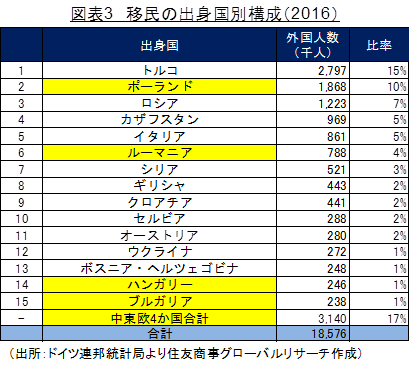
Either way, it left me with the sense that Japanese people just don’t come to Europe much. Take, for example, data on the countries of origin of immigrants to Germany. Mostly neighboring countries, it turns out (Eastern Europe especially).
〈The Concept of Stopping〉
The first thing you notice going to Europe is how the cityscape is built while preserving so many old buildings. In Japanese terms, it’s like the Kyoto-style cityscape existing everywhere.
Looking down at European cities from the sky, they’re astonishingly brown. That’s because the roofs are thoroughly unified. When I was young I only thought “that’s kind of cool,” but this hints at one reason Europe arrived early at a concept the present age needs.
That concept is “stopping.”
Preserving a cityscape as it is requires some kind of compromise somewhere. You can’t build skyscrapers, you can’t set up giant plants. But they accepted that compromise.
“Things of value must be left as they are. If necessary, we won’t hesitate to spend money on that.”
What needs that now is the global environment.
Starting from planetary boundaries, several Tipping Points are now academically defined, and they’re being monitored and managed so that we “can stop,” with the expectation that further innovation will emerge from that.
While America, and Japan following its lead, hesitated, thinking “uh oh, do we really have to stop? that sounds rough (let’s fudge it a bit),” Europe moved early to change course in various ways — and this is one reason that makes sense.
〈Trash on the Street〉
Around San Siro after the match was awful.
That’s an extreme case, so it’s not entirely fair to cite it, but on the whole, in terms of dirtiness, the order is:
Milan > Berlin >>> Japan
In particular, whether it’s because regulation of smoking while walking is lax, or nonexistent, the amount of cigarette butts in both countries is absurd. Legally, smoking should be banned outside designated areas and private spaces, but in practice it seems to be effectively ignored.
This is a bit different from California, where smokers seriously hide to smoke.
〈Summer Berlin Is Genuinely Heaven〉
A morning walk in early September still. Stepping out with a thin long-sleeved jacket on, the slightly cool air hits your face, the sunlight isn’t especially strong but keeps a warm feeling to it, and yet you don’t sweat at all. Is there such a thing as heaven-like weather???
Milan, by comparison, was a bit hot. The temperature itself wasn’t so different from Japan, only the humidity was low. Laundry hung indoors dries overnight. What is this?
Coming back to Milan from Berlin, I thought “yeah, it’s hot after all” (in fact I sweated under my mask on the train), and it made me shudder to think how much more humid Japan is than this.
〈The Smell of Tech〉
In Milan, finding even a trace of tech is hard work. That said, the abundance of shared scooters and shared bikes is insane. Just glancing around, I counted at least 10 companies operating them.


Berlin, being an industrial city, makes it easy enough to find electronics retailers too. But it pushes hard on being an art city, and the shadow of tech is thin there as well.
Rather, Sustainability as a theme was visible especially among young people, with a certain presence. The adoption of shared scooters is also tech within that same context.
Simply being “tech” and having it land with people is already deeply out of date, at least in Europe.
〈The Strangeness of Tokyo, Where the City Never Ends No Matter How Far You Move〉
In Europe it’s said that cities are built around a church. That’s true of regional cities, but not necessarily in big cities.
Still, the structure itself doesn’t change anywhere: there’s a city center, and outside its perimeter lie the suburbs (the open, green-rich areas).
So how far out is that?
Not just in Europe, but going by my sense of other countries, it’s about 20 or 30 minutes by car.
By contrast, in Japan — Tokyo especially — even after driving 30 minutes from Marunouchi, going west you’re still in Shibuya, going east you’re still in Odaiba. Going north you might just reach Kita-Senju, and going south you might not even make it to Kawasaki.
Tokyo is abnormal.
〈The Discomfort of Only Japan Being Hard to Move Through〉
Moving around in Europe was comfortable. No need to worry about how you behave, and there were no restrictions on moving between countries in the first place.
At the very last stretch, coming back into Japan, hassle was waiting.
That said, border measures had eased considerably (PCR testing is no longer required).
But the app (MySOS) I installed purely to enter Japan gave me nothing but trouble. I only realized the day before that it needed to be set up several days ahead. The instructions weren’t clear about how to import vaccination records, so I had to search online. There was no explanation of which screen I needed to display upon arriving at quarantine, and displaying it required an internet connection. Every WiFi network at the airport was congested. The mobile network worked but the signal was weak. 5GHz looked open, but in the end it was slow, and there was nothing to do but wait.
I was thoroughly fed up.
If a Japanese person feels this way, I can only imagine what people from other countries make of it.
I took the bus from the airport, and it was, in a way, a bit amusing that none of the people getting off international flights were wearing masks while waiting for the bus (outdoors) — though of course, neither was I.
Originally published in Japanese at https://clazytech.com/2022/09/1403/. Translated with LLM assistance and reviewed before publication.