Arsenal's Season Of Change Becomes A Story Of Revival
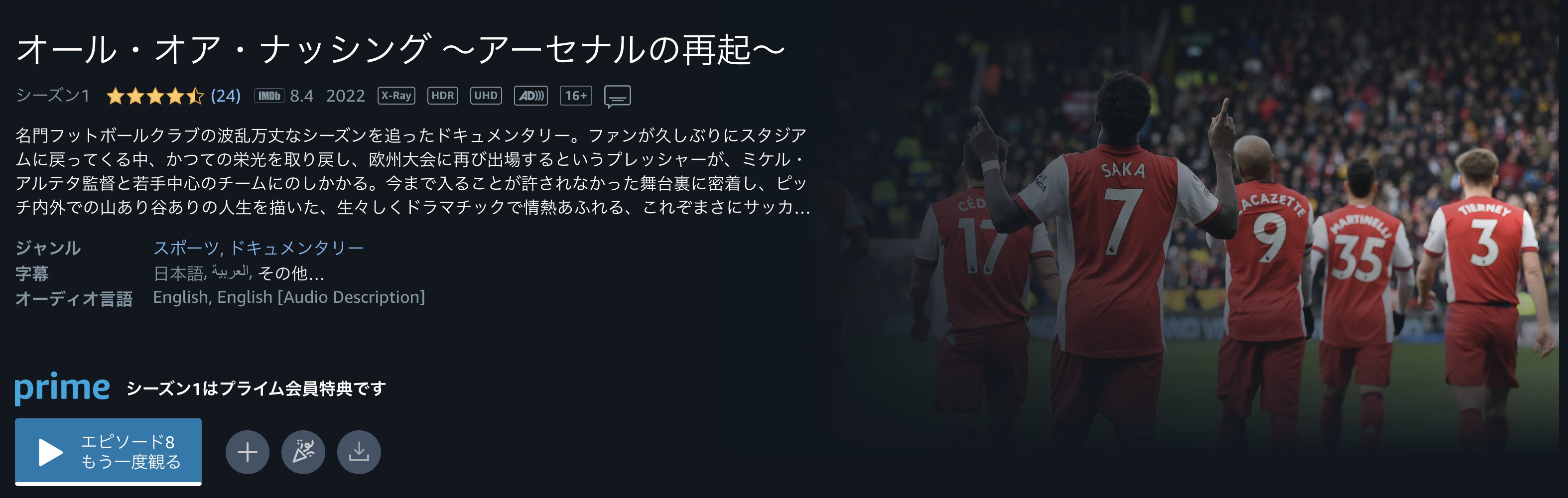
I watched Amazon Original’s All or Nothing: Arsenal all in one sitting on a flight to Europe.
The 2021/22 season was a season of change for Arsenal. In that sense, choosing this particular season as the subject was a brilliant call.
Calling it simply “a season of change” undersells it, because the finish was hard to categorize: from finishing 8th two years running to finishing 5th, narrowly missing out on the Champions League. A breakthrough? A leap forward? A comeback? None of those quite fit.
But something big definitely shifted. And looking at the start of the 2022/23 season, everyone must now be convinced Arsenal did break through, leap forward, and come back. First, for those not too familiar with Arsenal, let me briefly summarize what happened in the 21/22 season.
They started with three straight losses. A fourth would have made Premier League history for the wrong reasons. New signings Aaron Ramsdale and Tomiyasu saved them. I watched the fourth match live, and the defense was clearly more stable. The goal was a bit lucky, but it’s hard to imagine a team defending like that losing.
<From a lack of goals to Aubameyang’s departure>
They climbed from the bottom of the table to mid-table and even won away at Chelsea, but the wins didn’t stack up as fast as they should have. The reason was obvious: a lack of firepower up front. Smith Rowe, Ødegaard, and Saka carried the team. Meanwhile Aubameyang, who had been coasting through games, committed a disciplinary breach — unilaterally delaying his return from absence — and badly damaged his relationship with Arteta. Arsenal ultimately sent him to Barcelona in the winter transfer window. Many found it sensational that a veteran legend who had scored over 90 goals for the club was shown the door, and not on good terms.
Tomiyasu, Tierney, Partey and others were sidelined one after another with injuries. Elneny fought hard, but neither Cédric nor Tavares could match the regulars at fullback, especially defensively. There was even the embarrassment of losing three straight to lower-table opponents, and Arsenal fell out of the Champions League places.
Then the front-line players began to click: Lacazette and Nketiah started shining, Leno stepped up in matches Ramsdale missed, Holding performed well in matches White missed, and Arsenal steadied the ship, arriving at a direct clash for 4th place against 5th-placed Tottenham. They lost that match, the points swung the other way, and with one match left, it was over.
As a longtime Arsenal fan, it was disappointing, but there’s no question the season showed enormous hope for the following year. The phrase I kept repeating on social media that season was “Arteta is starting to look like a great manager” — and he really did get a little closer to that status.
Now, here’s what I thought after watching the main content of All or Nothing.
<Saka’s inner struggle>
I knew about what happened at the Euros — Saka missing the penalty and losing — but honestly I hadn’t thought much about it. Pépé, the money pit, played a lot at the start of the season too. But Saka is still 19. It was striking to see Arteta stand by him like a father while Saka had lost so much confidence. There was even a scene where a team staff member said, “Arteta has started talking to the players much more.”
A defining feature of this series is how it shows locker room scenes from many matches, letting you see in detail what the manager and players talk about before games. Arteta’s messages are intense. In short:
- Anyone who can’t value every single play is trash
- Go with the high press, and if you can’t, get off the pitch
- Raise your level, get to a level higher today
He drives these messages home with his whole body. He draws pictures on the whiteboard, does hand exercises with the team, and does all sorts of things — it was impressive.
It was also amusing when he casually announced before a match, “Starting today, anyone who takes body contact from an opponent in this area gets fined.” That turned out to be about setting up a zone for quicker ball release.
In the locker room after a bad loss: “I can’t accept the way you played today” — banging on the table and slamming the ball basket around — “but leave the outside stuff, dealing with the media, to me. That’s my responsibility. I’ll protect you.”
The directors never appear in public and only get criticized when the team loses. They have no chance to respond, and no way of influencing the match itself. That’s their position. Over lunch with Arteta at the clubhouse:
“Whatever happens, we’re on your side, Arteta. Don’t worry about the noise. Just don’t forget that.”
They say this gently to him. This man’s stomach must be riddled with ulcers.
<The behind-the-scenes story up to Aubameyang’s transfer>
The documentary covers plenty of staff conversations too. Particularly interesting is the somber exchange during the period when Aubameyang trained separately after his disciplinary breach. At first the front office thought releasing him would be impossible, because his salary was too high. A loan deal might have worked, but the club didn’t want that. The best outcome would be a mutual termination of his contract, making him a free agent. The front office didn’t even know when Aubameyang went and pitched himself to Barcelona on his own. Barcelona later offered a loan, which the club turned down, but then at the very last moment, four hours before the deadline, a permanent transfer offer arrived, and there’s a scene of the back office scrambling to finish the paperwork and submit it to the league in time.
<Xhaka, who basically always slams his boots down>
Xhaka has a fiery temper on the field too. In the locker room, when they lose, he usually slams his boots on the floor. But this same Xhaka, playing with his two daughters, says, “I’m only 28 but I’m already a veteran on this team. I feel the responsibility.” “People who criticize will criticize over anything. I think they forget that I’m human too.” Yes… sorry, I was one of the people criticizing him. I mean, come on.
Come to think of it, before the season neither Martinelli nor Nketiah were players anyone expected to shine. But you can watch them seize the chances that came their way over the year and grow dramatically, climbing the ladder step by step. Arsenal is an extremely young team, and that growth became a weapon that drove a huge change within a single season. Is this really down to “Arteta the great manager”? Does it prove his eye for talent is not to be doubted?
<Elneny’s Ramadan>
The stretch covering Elneny’s fasting is quite interesting. The medical staff strictly measure his muscle mass to make sure he doesn’t fall out of condition. Interestingly, his muscle mass actually increased and his body felt sharper as a result.
For players under intense pressure and stress, family support is extremely important. Similar episodes come up with many of the players.
There’s no need to listen to people who say nice things when you’re doing well and disappear when you’re struggling. The people who stay with you through good times and bad — that’s family. So you should always listen to what your family says.
I believe that one was Ramsdale.
<Tomiyasu doesn’t get much screen time. Lol>
He barely appears. He’s probably not as much of a “team idol” as Japanese fans imagine. That makes sense. Arsenal is packed with promising young England internationals, plus national-team-level players from France, Switzerland, Scotland and other neighboring countries, and Brazil too. You have to become even more of a core player before you get featured in a documentary like this.
<It felt like it was ultimately Arteta’s growth story>
Above all, Arteta loves football. His wife says, with an exasperated look, “When he’s home, he’s watching football in his study 24/7, 365 days a year.” Being called the youngest manager in Premier League history sounds impressive, but honestly, he had only had disappointing seasons up to that point. A young team is fragile when it breaks down. They even lost 0-3 to Crystal Palace. Doing it yourself is different from watching. It’s not as simple as bringing in good players and handing them good tactics. How do you build a group that keeps fighting? How do you get everyone to fight with strong confidence and conviction? The struggle runs deep.
But looking back at the 21/22 season, whenever Arteta boldly changed the starting lineup, things generally turned out well. I think this proves how properly he cared for the substitute players through their everyday training and life. By giving everyone that kind of stimulus, without locking in a fixed starting eleven, he gradually fostered genuine competition and growth within the team as the season went on. That’s considerable management ability.
Did he get closer to being a great manager after all? The proof of that carries forward into the 2022/23 season.
Originally published in Japanese at https://clazytech.com/2022/09/1372/. Translated with LLM assistance and reviewed before publication.