
Understanding Carbon Capture and Storage, Part Two
Continuing from the previous post
I’m summarizing, in several installments, what I learned from the online class “CCSx: Climate Change: Carbon Capture and Storage,” offered by Edinburgh University on edX. This is mainly for my own notes, but hopefully it’s useful to someone else too.
Areas where CCS is making inroads
Manufacturing: concrete and steel. And energy. Decarbonization that relies solely on pushing forward renewable energy and nuclear power will clearly exhaust the carbon budget within our generation. Restricting energy use itself is probably not ethically acceptable.
Carbon Negative / Carbon Neutral / Carbon Positive
Carbon Negative refers to things like BECCS and DAC.
Carbon Neutral includes facilities powered by hydrogen or fossil fuel heat, but strictly speaking these aren’t fully neutral, since primary energy generation still emits into the atmosphere.
CCS can push these “not quite neutral” facilities closer to neutral or negative, and by working in Carbon Positive facilities such as oil, coal, and natural gas plants, CCS can make a large contribution to CO2 reduction.
The four stages of technology rejection
- Regarded as infeasible science fiction
- Regarded as expensive, complex, and nearly impossible
- Regarded as requiring large investment but necessary
- Becomes commonplace
Power generation has passed through these four stages and arrived at stage 4. Sulfur offers another example. The source of acid rain, it was recognized as a problem in the 1970s and 1980s and was solved over 20 to 30 years through advances in desulfurization technology at thermal power plants. Its cost has now fallen to less than 1/5 of the projections made around 1990, and continues to fall.
Where does CCS stand in this sequence right now?
Cement
Discovered in England in the 19th century. Producing a ton of cement emits 800kg of CO2. Global production runs 4 billion tons per year. In fact, cement production accounts for 1/5 of all CO2 emissions.
Cement is made by crushing and mixing limestone (calcium carbonate), silicon, aluminum, iron, and other materials, then heating them to 1400°C. Here the reaction
CaCO3 -> CaO + CO2
takes place.
According to IEA estimates, 30% of cement production facilities must have CCS attached by 2050.
Steel
Steel production emits 1.5 to 3 tons of CO2 per ton produced. The world produces 1.5 billion tons, accounting for roughly 1/6 of total CO2 emissions.
Blast furnaces exceeding 2000°C bring iron ore into contact with a specific type of coal. Two-thirds of the total CO2 is emitted there.
Efforts are underway to reduce total emissions through means such as scrap steel recycling, but no one has found an alternative to coking coal, and there’s no decisive solution for a category being asked to cut emissions by more than 80%. This is an area where CCS is needed.
Fertilizer production
The chemical fertilizer market is global in scale and enormous. It’s expected to keep relying on fossil fuels. CCS can also be readily introduced here.
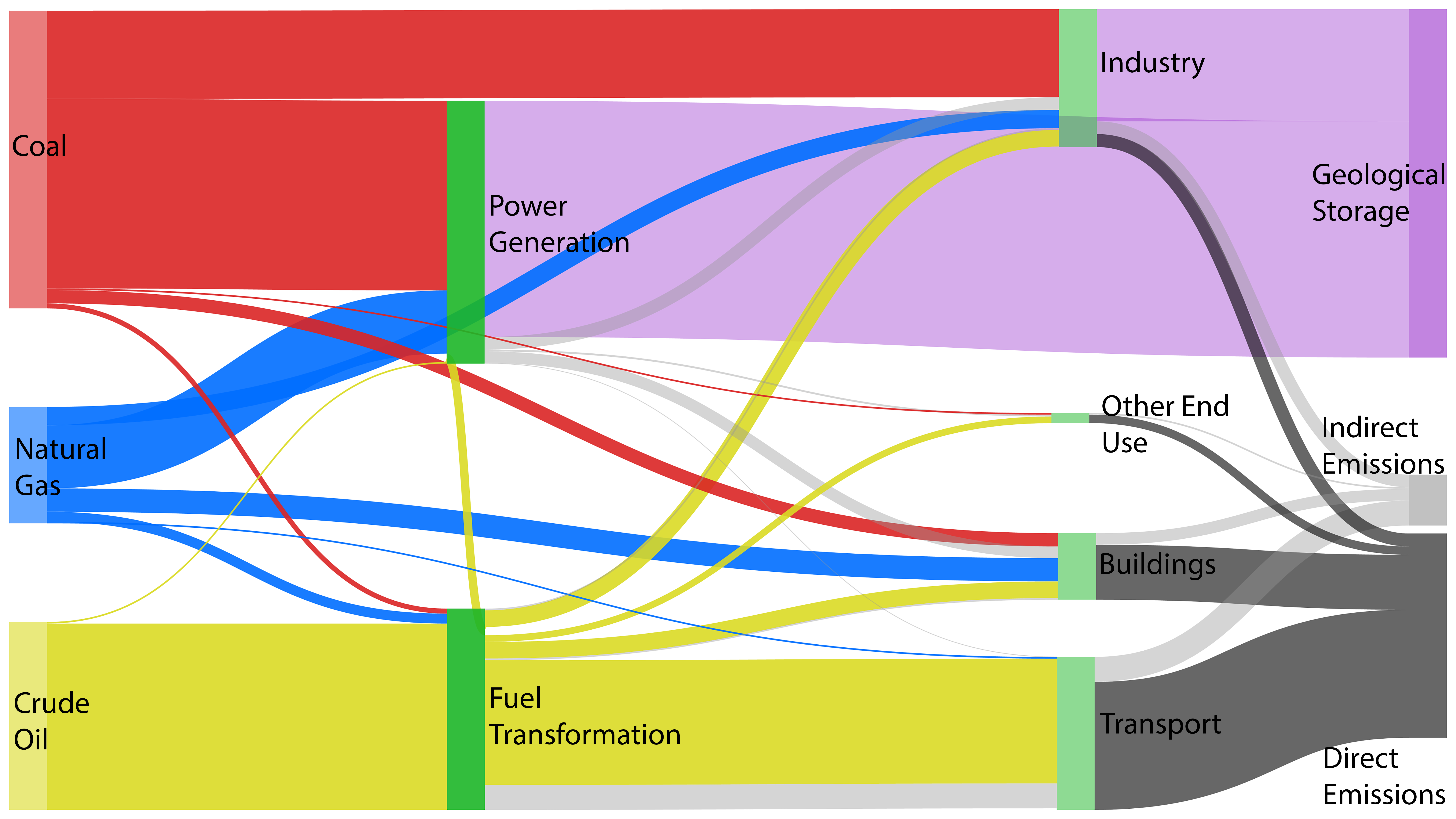
Sankey Diagram
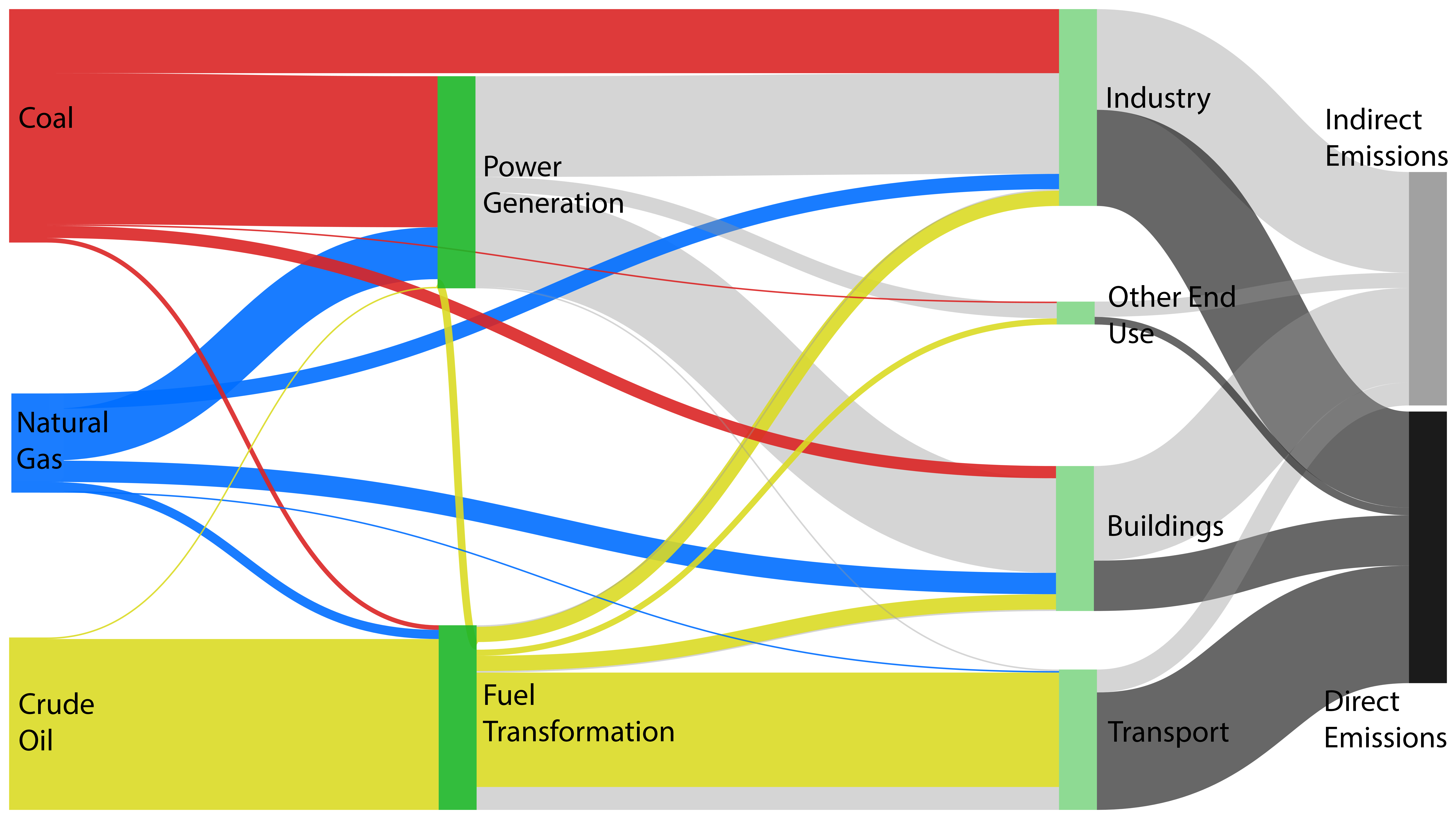
A typical way of representing energy balances.
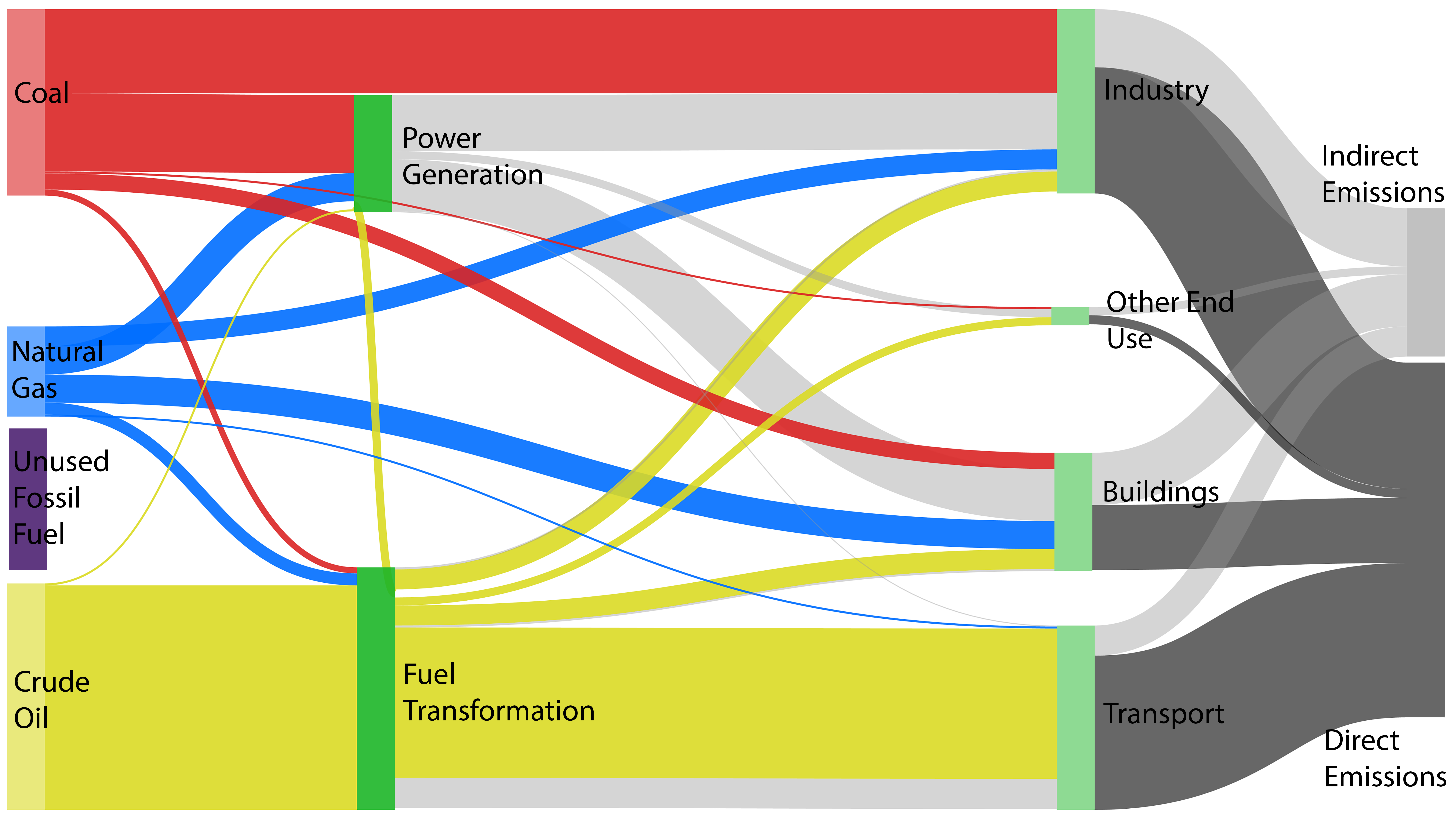
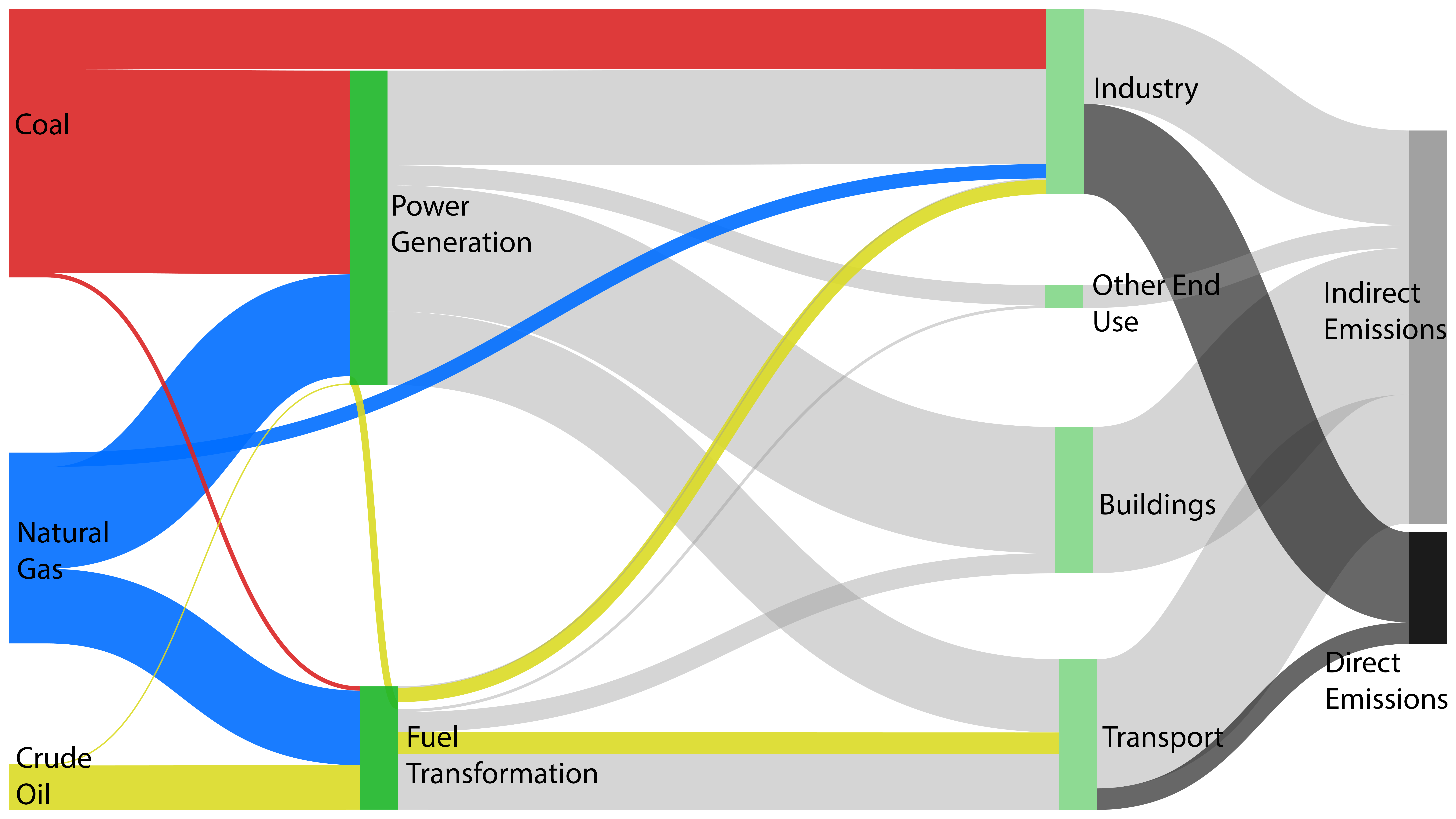
Direct Emissions refers to direct emissions from things like cars. Indirect Emissions refers to indirect emissions such as those from electricity use. You can see how a great deal of coal goes into power generation, and how that in turn flows into construction. Stopping each of these individual flows will lead to CO2 reduction.
When renewable energy enters the picture, it changes like this.
When hydrogen energy becomes commonplace, it changes like this.
When CCS is also added, it changes like this.
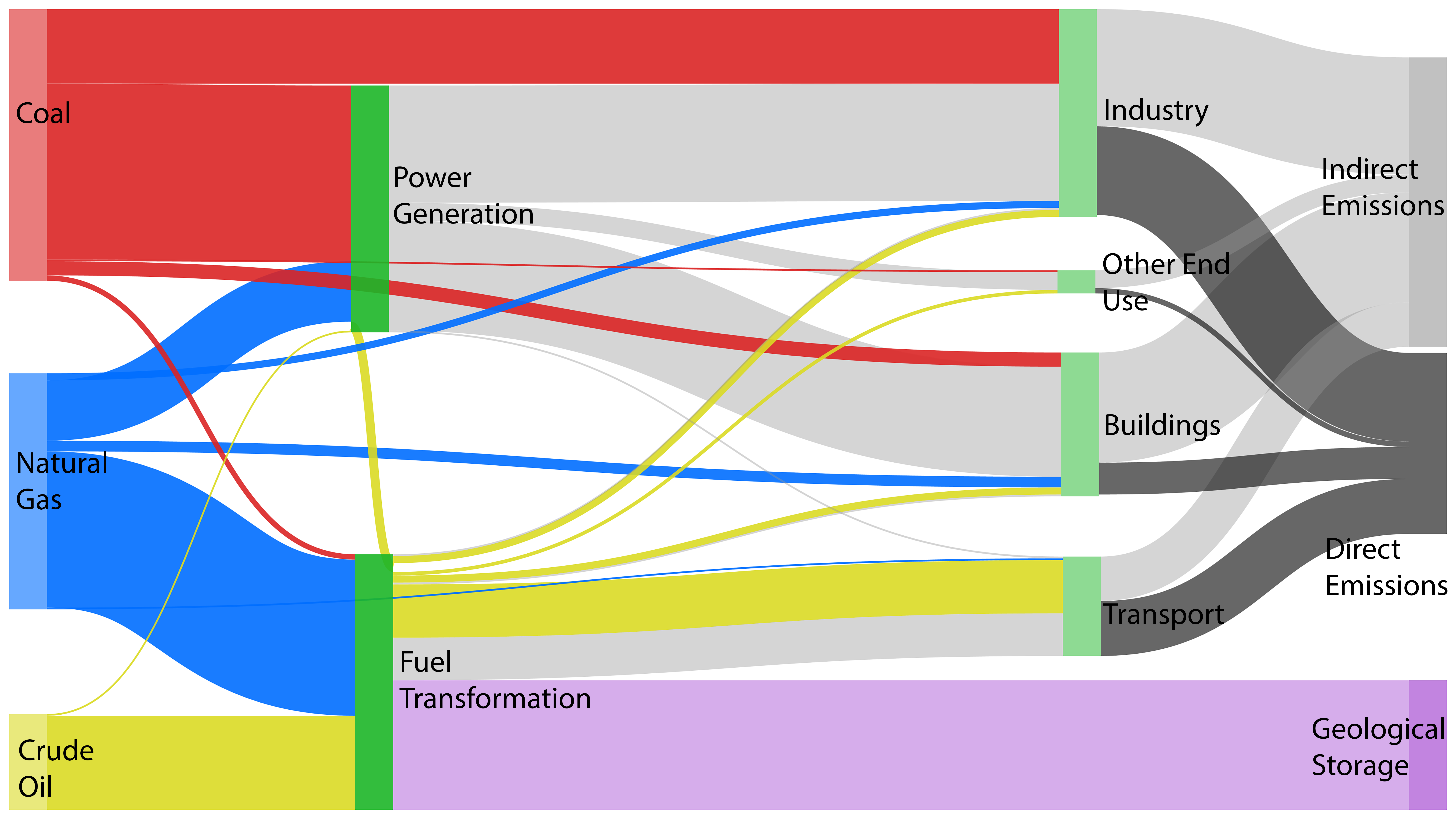
When CCS enters heavy industry, it changes dramatically.
Hydrogen energy
City gas is 50% hydrogen. It’s actually already a familiar energy source. Currently, most of it is made from natural gas, a process that emits methane (CH4) and ultimately CO2. CCS is a very good fit here.
Infrastructure development of pipe networks to supply hydrogen is proceeding actively in the UK, and the cost outlook is favorable.
Leeds case study video
Northern Gas Networks H21 Leeds City Gate film
Blue Hydrogen and Green Hydrogen
Hydrogen produced using CCS is called Blue, and hydrogen produced by electrolysis is called Green. For Blue Hydrogen to reach Net Zero overall, reducing methane leakage in upstream processes is a major challenge.
A 100% renewable energy society
Some people aim to supply all electricity from renewable energy. This may not be efficient at all, though.
The main players in renewable energy are wind and solar, but neither can generate power on demand. For this reason, some have proposed simply oversizing wind power capacity to increase generation capacity. There’s also a movement to plan cross-border transmission grids, based on the idea that “the wind is blowing (or the sun is shining) somewhere on Earth.” But given the low utilization rates of this infrastructure, it’s quite likely not cost-efficient.
The problem of electricity storage also has an unclear path to resolution. For example, weather scenarios estimated to be possible within the next 10 years include a high-pressure weather system bringing cold, windless conditions worldwide for several weeks. In other words, seriously pursuing a “100% renewable energy society” would require an electricity storage system capable of enduring several weeks with almost no wind or solar power available. Frankly, this is an extremely unrealistic proposition at present.
So options such as nuclear power, low-carbon thermal power generation, and BECCS will definitely be necessary. IPCC estimates suggest that without CCS, the cost of meeting the 2°C target would rise by 50-200%.
On the cost of 100% renewable energy
Power generation
Power generation-related emissions are said to run 13Gt per year, 40% of total CO2 emissions. This is more than double the transport sector’s share (2014 data).
Countries with access to cheap natural gas can achieve “emissions reductions” for now by shifting to it, but that alone won’t reach neutrality.
More than 50% of renewable energy comes from wind and solar, but because these can’t operate on demand, old thermal power plants can’t be closed. It would be better to convert them into low-carbon thermal power plants using CCS.
Originally published in Japanese at https://clazytech.com/2022/08/926/. Translated with LLM assistance and reviewed before publication.