Understanding Carbon Capture and Storage, Part 1
I took the online class “CCSx: Climate Change: Carbon Capture and Storage” offered by Edinburgh University on edX.
https://learning.edx.org/course/course-v1:EdinburghX+CCSx+3T2020/home
You get a certificate like this after finishing the course (for what it’s worth).
https://courses.edx.org/certificates/48fa366825894691a33a4f3deab01760
I’ll summarize what I learned over a few posts, mainly as notes for myself (and hopefully useful to someone else too).
A Simple Explanation of CCS
Most CCS facilities currently in operation are installed at fossil fuel and biomass fuel power plants. They capture the CO2 generated, compress it into liquid form, and inject it via pipeline into storage reservoirs several thousand meters deep, such as depleted oil and gas fields or saline aquifers, isolating it from the atmosphere on a semi-permanent basis.
The energy needed to run CCS itself often comes from surplus power at the plant or from renewable energy.
Global CCS Map
https://www.sccs.org.uk/expertise/global-ccs-map
This lets you see the operational status of CCS facilities around the world and how many Gt of CO2 per year they are planned to sequester.
Where Is Carbon Located?
Carbon dioxide (CO2) is a trace gas in the atmosphere, making up about 0.042% of the atmosphere, or 1 molecule in every 2400. Before the industrial revolution it was reportedly 0.028%, or 1 molecule in every 3500.
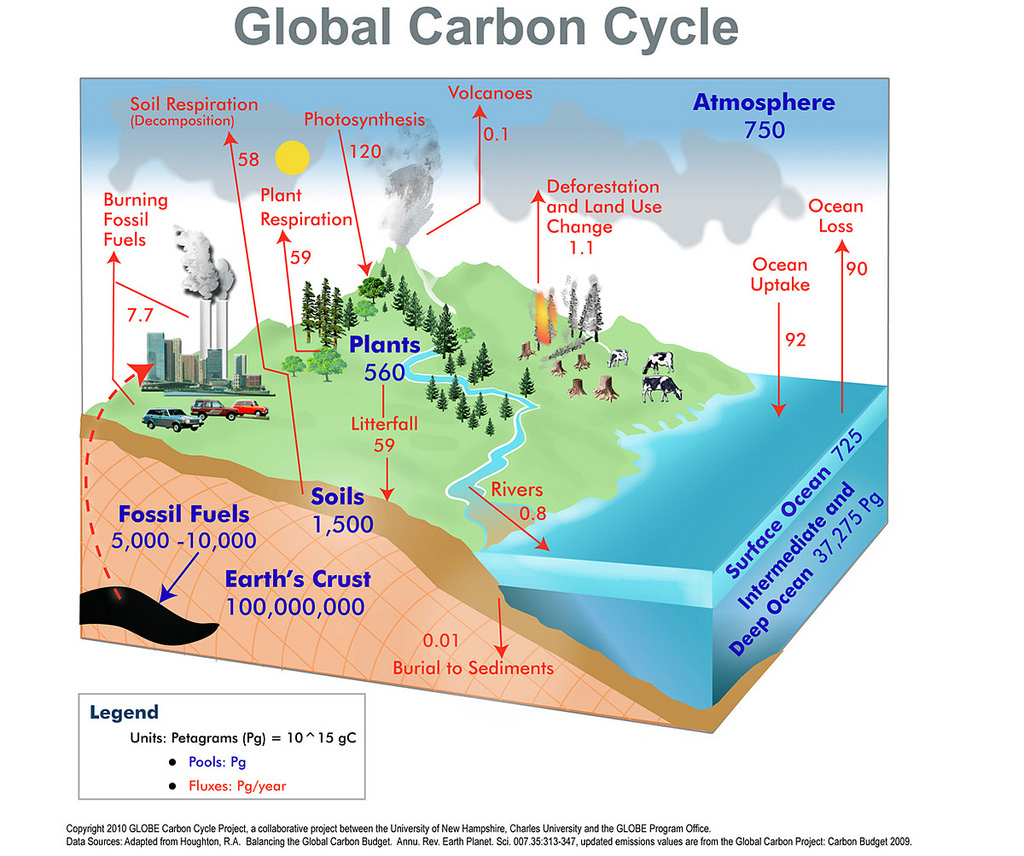
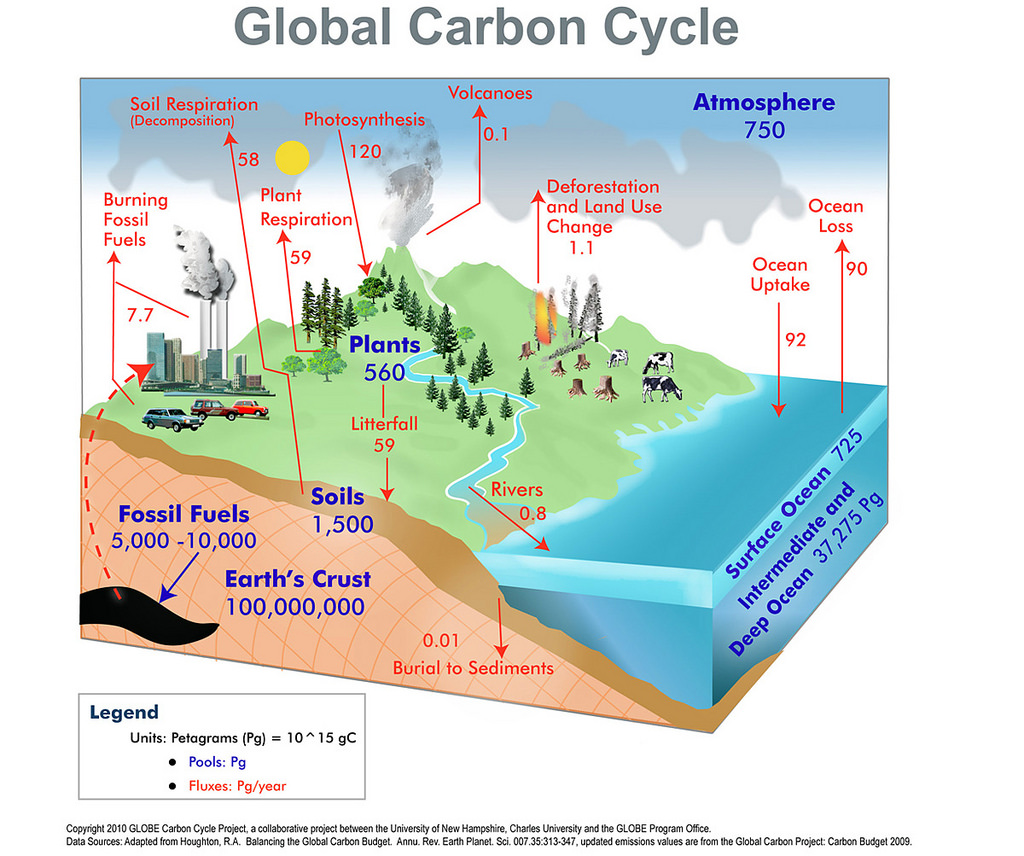
The figure above is very useful for understanding where carbon is stored and how it moves between reservoirs. You often see similar diagrams in IPCC reports and elsewhere.
A few things become clear from it:
- The scale of geological storage is orders of magnitude larger than everything else
- It differs from the atmosphere or plants by 5 or 6 orders of magnitude
- Even compared to the deep ocean, which is often thought of as storing large amounts of carbon, it differs by 3 or 4 orders of magnitude
- The amount extracted as fossil fuel and the amount returned to the geological cycle are wildly out of balance
- The scale of geological transfer is very small compared to the scale of carbon exchange between the atmosphere, biosphere, and ocean
- Burning fossil fuels plus deforestation together amount to roughly 100 volcanic eruptions’ worth
- Without human activity, there is essentially no way atmospheric CO2 would have increased
Global Warming Scenarios
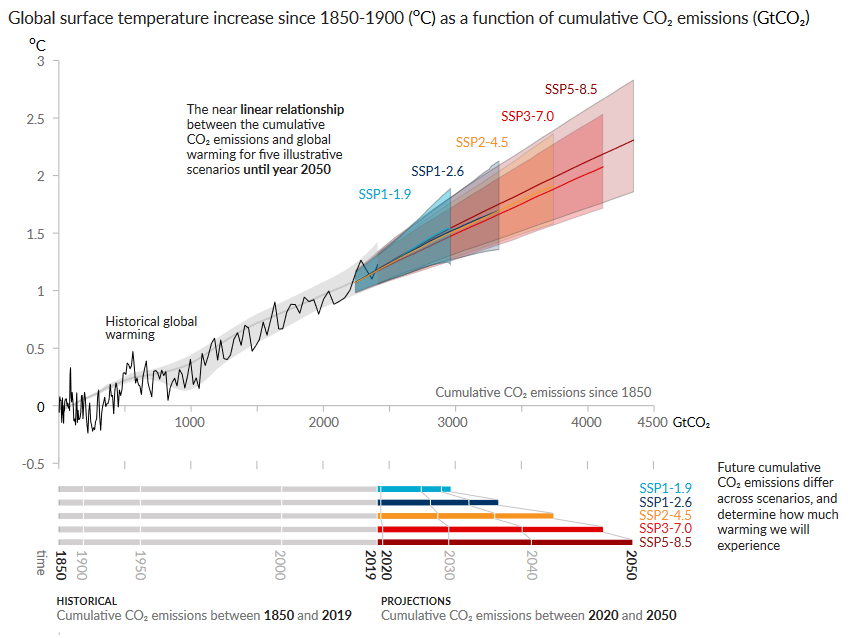
The above is an example of a warming scenario published by the IPCC.
The horizontal axis shows the cumulative amount of CO2 accumulated in the atmosphere since the industrial revolution. The vertical axis shows the corresponding temperature rise. Various scenarios are modeled depending on changes in nature and industry, but broadly speaking, if the goal is to keep the temperature rise below 2°C, total emissions need to be capped at 3000Gt.
Put another way, once total emissions exceed 3000Gt, “emissions < removals” must hold from then on, permanently. (That budget is called the Carbon Budget.)
Current estimates put the remaining headroom at roughly 1000Gt.
Image: Figure SPM. 10, IPCC, 2021: Summary for Policymakers. In: Climate Change 2021: The Physical Science Basis. Contribution of Working Group I to the Sixth Assessment Report of the Intergovernmental Panel on Climate Change [Masson-Delmotte, V., P. Zhai, A. Pirani, S. L. Connors, C. Péan, S. Berger, N. Caud, Y. Chen, L. Goldfarb, M. I. Gomis, M. Huang, K. Leitzell, E. Lonnoy, J.B.R. Matthews, T. K. Maycock, T. Waterfield, O. Yelekçi, R. Yu and B. Zhou (eds.)]. Cambridge University Press. In Press. available here.
One thing to be very careful about: any discussion of warming here refers to “global average temperature.”
This means it’s entirely normal for it to diverge sharply from an individual’s personal sense of “summers have been brutally hot lately” or “we’ve had a lot of cold snaps the past few years,” depending on where they live.
A change of just 1°C or 2°C, averaged over the entire surface of the globe and further averaged over a full year, is essentially impossible to perceive except as a statistic.
So conversations along the lines of “because of global warming lately, XX is happening” need to be treated with caution. In most cases, what’s actually being discussed is a localized trend in seasonal winds, ocean currents, or pressure patterns over a span of a few years to a few decades. Whether the Earth is warming or cooling, Arctic ice will melt a lot in some years and not much in others.
The Paris Agreement
The Paris Agreement, agreed in 2015, was a groundbreaking framework involving countries that together account for 55% of global emissions. The US withdrew in 2017, but the coalition held together regardless, and the US rejoined in 2021.
Climate Action Tracker
https://climateactiontracker.org/
A site where you can track whether each country’s efforts in various categories are consistent with the “below 2°C” or “below 1.5°C” targets.
The Dilemma Facing CCS
CCS can be installed at plants that use fossil fuels, capturing and sequestering the CO2 they emit immediately. This opens the door to a logic in which industries like oil choose to invest solely in CCS rather than in cutting CO2 emissions, on the reasoning that once the capture rate reaches 100%, the Carbon Budget will never be hit.
But following that logic risks pouring excessive investment into CCS, a field that still has considerable room for improvement in cost and equipment, and needlessly driving up the cost of carbon capture.
Carbon Overshoot
In the IPCC’s reports as they currently stand, most scenarios already assume that future carbon emissions will exceed the “2°C line” — in other words, an overshoot. Put the other way around, this means it’s already taken as a given that negative emissions from removal will be required.
The amount of removal needed this century is said to be 600–800 billion tons.
Tipping Points
Explainer: Nine ‘tipping points’ that could be triggered by climate change
Provided by the European Climate Foundation. A list of “if this happens, climate change gets really bad.” Currently nine tipping points are listed.
The Importance of BECCS
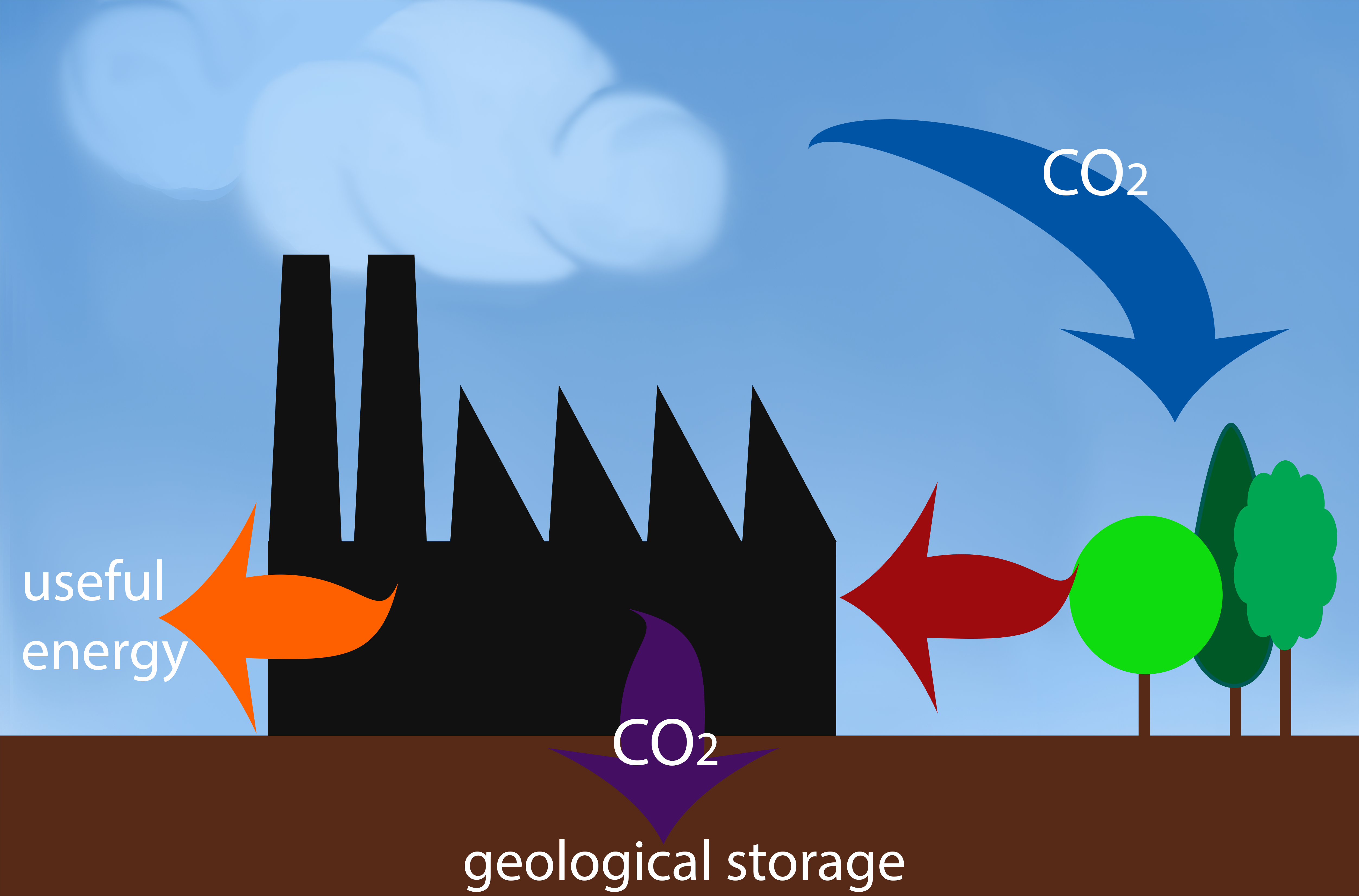
BECCS is the fusion of bioenergy and CCS. There’s nothing particularly difficult about it technically. It’s simply using CCS to geologically sequester the carbon released when generating power from biomass fuel.
What matters here is that, via a somewhat roundabout process, it manages to move carbon from the atmosphere into geological storage.
Plants absorb CO2 from the atmosphere and store it in their own tissue. But eventually this carbon disperses back into the atmosphere. That cycle takes a few decades to, at most, around a century, far too short a timescale when what’s needed is semi-permanent carbon sequestration.
In other words, by the same logic, simply using biomass fuel without further thought solves nothing. Burning it just returns the carbon to the atmosphere.
Combine it with CCS, however, and you get a chain running from atmosphere to plant to energy to geology. Since you also get energy out of the process, the benefits are considerable.
Why Isn’t Just Planting Trees Enough?
One reason is the short duration of carbon sequestration by plants. The buildup of atmospheric carbon since the industrial revolution is a problem that needs to be resolved over the course of centuries, and one that must never be allowed to recur, semi-permanently. Sequestering carbon for only a few decades to around a century isn’t an adequate solution.
Trees also only absorb carbon mainly during the period when they’re actively growing.
Another reason is the pressure that afforestation places on farmland.
Consider what it would take to cancel out the world’s CO2 emissions through tree-planting alone: per-capita CO2 emissions vary enormously by country, from 0.03 to 37.29 tCO2 per year, with an average of about 4.79 tCO2.
The amount of CO2 a tree can store also varies by species, location, and age, but an average tree absorbs about 25kgCO2 per year. Assuming every tree planted survives, offsetting one person’s CO2 emissions would require planting 192 trees every single year, continuously.
A dense forest can hold about 2500 trees per hectare. A single square kilometer of land could hold 250,000 trees, offsetting the annual emissions of 1300 people.
At first glance this might seem like a promising approach, but offsetting the annual emissions of roughly 7 billion people would require newly planting 6 million square kilometers of forest every year. That’s 1.8 times the total area of India.
In other words, unless you’re committing to a plan of planting the equivalent of two Indias’ worth of forest every single year, you can’t casually say “just plant trees!” By 2050, Eurasia would end up covered in nothing but forest.
Land suitable for afforestation is also, in most cases, land suitable for farming, which forces a choice between reducing existing farmland or planting trees instead of creating new farmland needed for food security. Scaling down the afforestation effort makes it easier to reconcile with these other concerns, but it also reduces its effectiveness at cutting emissions. Unless this dilemma can be resolved, tree-planting isn’t a particularly effective measure for reducing CO2.
DAC = Direct Air Capture
We’re still buzzing from the launch of #Orca.
In case you missed it, watch our video tour that takes you through our history to retrace the milestones that enabled us to realize our vision of bringing large-scale #DirectAirCapture to reality.
Watch here: https://t.co/k7URCnC2Ey pic.twitter.com/qFMGF0eEQg— Climeworks (@Climeworks) September 23, 2021
This is a technology that captures carbon directly from the air and sequesters it underground as-is. Switzerland’s Climeworks can be considered the world’s top runner in this field. However, current projected sequestration volumes are still only in the thousands to tens of thousands of tons per year, and further innovation will be needed going forward. As of 2022, Climeworks has received over $780M in funding.
Note that nearly all of the content in this post is a summary and supplement of content attributable to “EdinburghX” (*CC-BY4.*0)
Originally published in Japanese at https://clazytech.com/2022/07/916/. Translated with LLM assistance and reviewed before publication.