Quinone Carboxylation Powers a New Carbon Capture System
DACC (Direct Air Carbon Capture) is a much-watched field, explicitly named in the IPCC’s Sixth Assessment Report as “not an option — the target cannot be achieved without DACC.”
But existing technologies (Climeworks, for example) require massive plants, need temperature and pressure swings for adsorption and release (which also means a heavy energy load), and carry very high costs. The challenges go on and on.
Verdox, introduced here, is an MIT-born technology with the potential to solve many of these problems.
Here’s the Youtube video:
This Is CDR Ep. 30: Verdox’s Electrochemical DAC - with Dr. Sahag Voskian and Jonte Boysen
Related papers by CTO Dr. Sahag Voskian:
https://pubs.rsc.org/en/content/articlehtml/2019/ee/c9ee02412c
He has also worked on amine-based research.
https://pubs.acs.org/doi/abs/10.1021/acssuschemeng.0c02172
There’s an article on this in Japanese as well.
ESA looks like an extension of battery technology
ESA (Electro-Swing Adsorption) adsorbs gas not through temperature or pressure but through electrical charge, via charging and discharging. It apparently originated in research on battery electrodes, where a method for fixing gas emerged, which then suggested the idea of applying it to carbon capture.
The actual operation is exactly that: charging the device adsorbs CO2, discharging it releases CO2.
The process by which quinone fixes CO2
The following diagram makes this easy to follow.
Quinone is essentially a benzene ring with two oxygens attached, and it captures carbon dioxide and transforms as shown below.
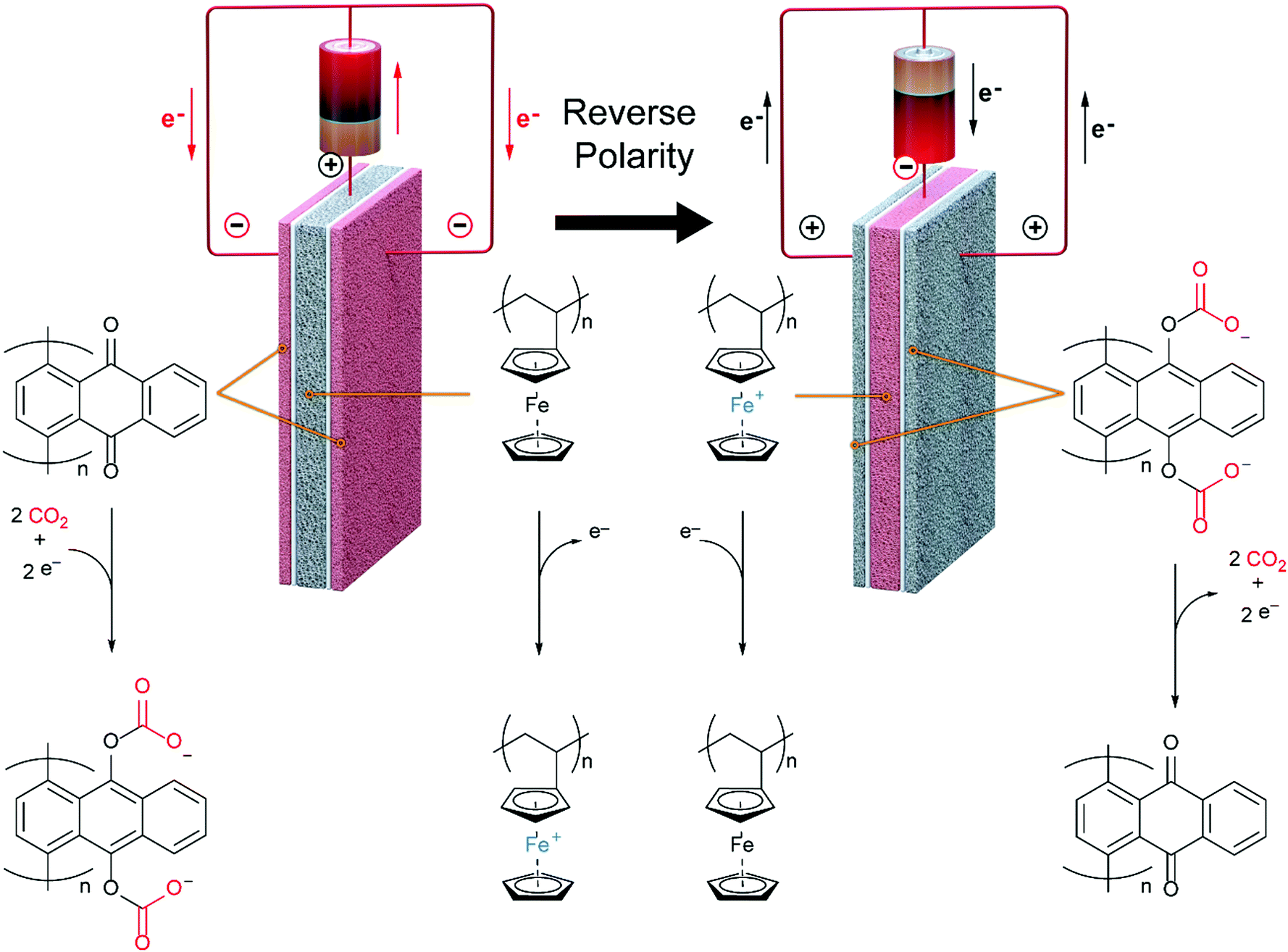
https://pubs.rsc.org/image/article/2019/EE/c9ee02412c/c9ee02412c-f1_hi-res.gif
Here’s a diagram that breaks the process down in a bit more detail.
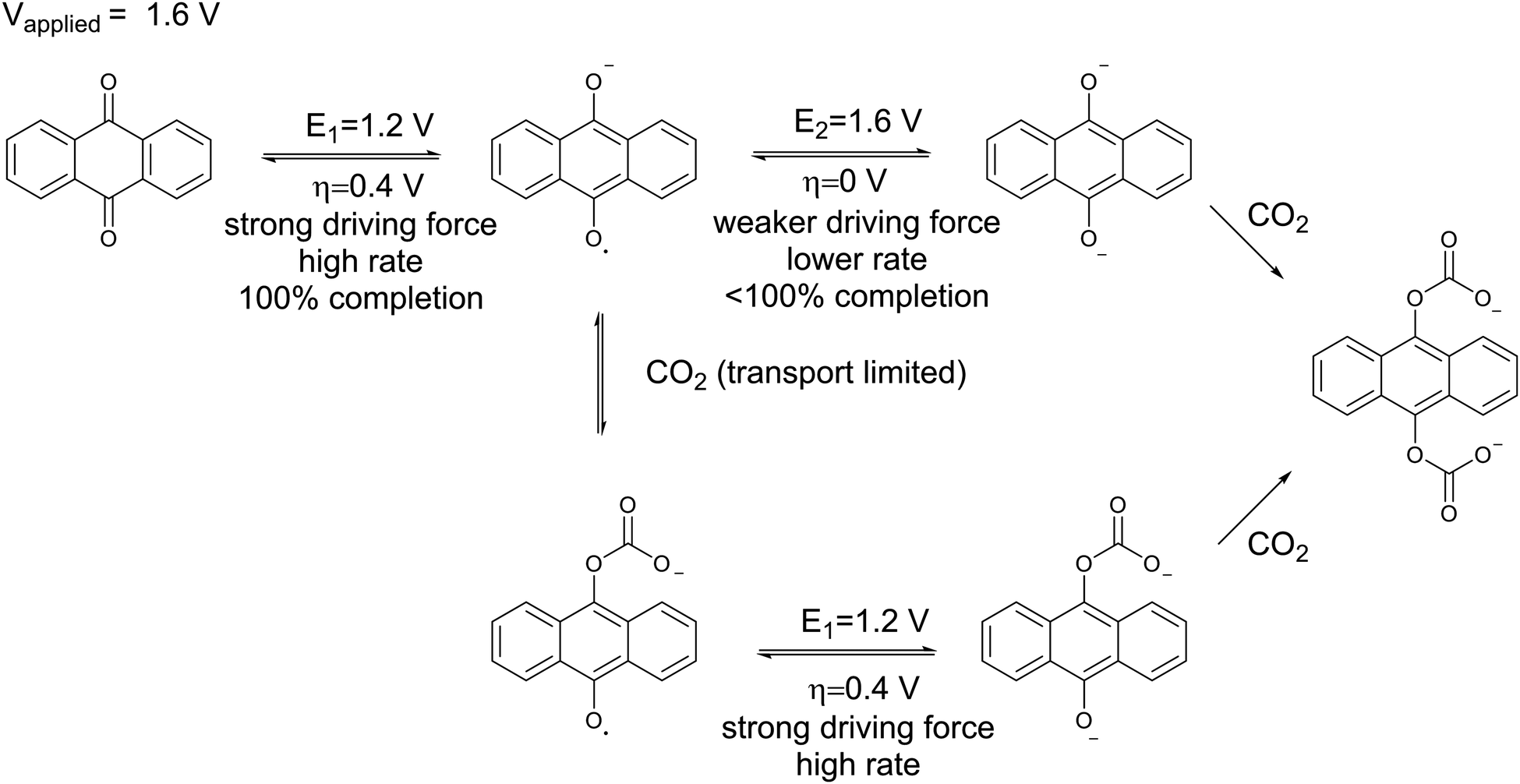
https://pubs.rsc.org/image/article/2019/EE/c9ee02412c/c9ee02412c-s3_hi-res.gif
Anthraquinone itself turns up here and there in research on artificial photosynthesis, as a substance that reduces carbon dioxide.
https://kaken.nii.ac.jp/ja/file/KAKENHI-PROJECT-25410102/25410102seika.pdf
Concentration
Compared with membrane-based approaches, the difference lies in how flexibly each handles concentration. Membrane-based solutions work effectively within a certain density range, but below that level they require vast surface areas and large equipment. Verdox’s quinone-based solution, by contrast, is said to operate stably at any concentration.
The promise of electrical capture (ESA)
Most of the “already realized” solutions in the DACC field use amine-based absorbents: CO2 is adsorbed, then heated inside a chamber to be released and recovered, then compressed into a liquid and sent to a pipeline.
That’s simply because technological maturation takes time, and because in this field practical deployment is almost synonymous with building a plant (after all, gigaton-scale capture is needed), which inevitably pulls things toward something that looks like a factory.
But electrical capture needs no giant heater, so the equipment stays compact and power consumption stays low. I imagined it running here and there off something as modest as a small solar panel.
Personally, I want to push back against the prevailing assumption that DACC equals a giant plant (plant engineering isn’t my specialty, after all), and on that point, ESA has stuck firmly in my mind as one compelling idea.
Originally published in Japanese at https://clazytech.com/2022/07/910/. Translated with LLM assistance and reviewed before publication.