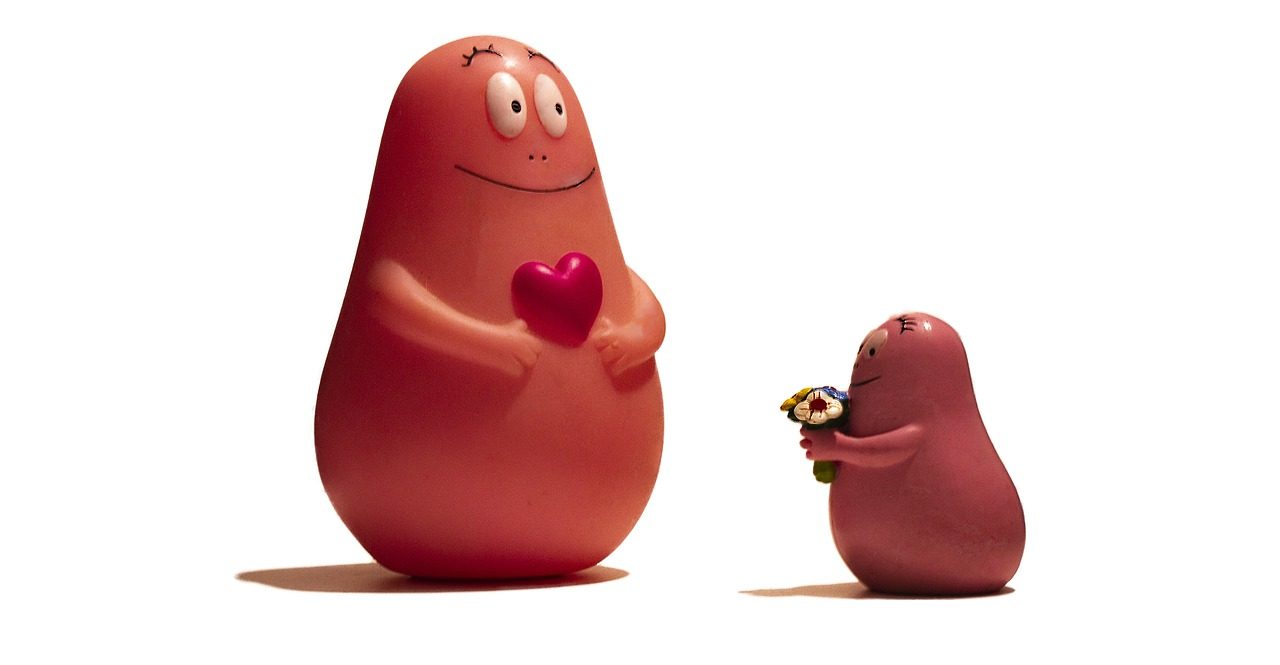
Barbapapa's Christmas gift already solved our energy debate
The content of the 1982 children’s picture book “Barbapapa’s Christmas Presents” is remarkably deep.
Or rather, maybe we’ve simply kept wandering, shallowly, in front of a point that was already made 40 years ago.
Let me lay it out in detail below.
The book’s content can be summarized as follows. Santa brought presents to the Barbapapa family’s house. Barbapicture’s present was African animals. But the Barbapapa family’s house is in a cold place. Blankets and warm clothing aren’t enough, and the animals will freeze, so Barbapicture, who’s good at inventing things, builds a mechanism for generating power and heating. First they try hydroelectric power, but it’s so cold the river freezes. Next they try wind power, but windless days drag on and they’re stuck. Solar is the same. Finally they switch to human power and everyone keeps pedaling. Everyone is exhausted. “Wait, if we keep pedaling we’ll get hot, so why not just have the animals pedal for themselves!” — right at that point, Barbapapa sets them straight. Let’s give them back to Africa, he says. The animals are safely returned to Africa’s nature, and in the end Santa brings a new present of animals that can live even in cold places, and everyone lives happily ever after.
The Barbapapa household is fundamentally eco-conscious and dislikes destroying nature and using fossil fuels, and this outlook shows up often in other stories too. They flee off-planet with animals to preserve biodiversity, or they fight for-profit companies that damage the environment. This particular story delivers the lesson that what matters is coexisting skillfully with nature, not altering it.
Shifting our view to the present day, there’s a strong faction insistently pushing renewable energy. The push toward energy diversity undoubtedly makes sense in terms of securing sustainability, and as an engineer I find it genuinely interesting and worthy of appreciation, but even so, I feel an extremely strong “imposition” running through it, one that comes from clearly deciding what is “good” and what is “evil.”
We need to curb massive consumption of fossil fuels. Agreed. Because they’re a finite resource. We should control CO2 emissions. Agreed. Because CO2 has several facets. For example, it can bring about a greenhouse effect, but it can also increase crop yields. Global warming is happening. We should be careful about it. Agreed. But the claim that human activity dominates over nature’s own workings (cycles spanning hundreds or tens of thousands of years, for example, such as the waxing and waning of sunspots or the state of atmospheric aerosols) — whether it’s warming or cooling — seems like an overreach based on a few cherry-picked pieces of circumstantial evidence. Incidentally, the IPCC’s AR5 report apparently noted that aerosol variation from cosmic rays, and its associated effect on radiative forcing, turned out smaller than originally estimated. I read the source material, but unfortunately I’m not a professional, so I couldn’t fully understand it — though the current state of affairs does seem to be that “there is disagreement.”
Still, I favor the stance that humans should do what humans can do.
This much seems to me like a perfectly fair perspective. And yet, I suspect many people in the world innocently believe the extreme view that:
- if CO2 emissions reach zero, warming will stop
- fossil fuel use should be reduced to zero
- everything should be switched to renewable energy
is the “universally agreed correct answer.”
I’d like people to think about this a bit more calmly.
Warming has been much talked about in recent years, but in terms of temperature alone, around 1960 it was cold, and the medieval period is known to have been much hotter than now. The same goes for the Jōmon period. But I can’t think of anything approaching a crisis for humanity caused by temperature in those eras. In the first place, when it gets warmer, human mortality rates go down. Some also hold the view that a warm climate, which makes crops grow well, may have played a part in the shift to settled agriculture. The same goes for sea level rise. From a purely human-centered standpoint, it would be a problem if Tokyo sank — but in the Edo period, the areas around Koto, Taito, and Chuo wards were already underwater. Polar bears are projected to have been increasing for decades now (since an exact head count isn’t possible, the method is apparently to estimate from several subpopulations, but for some reason the official figure now reads “Unknown,” even though a report clearly states “estimated at 26,000.” That part is unclear). https://polarbearscience.com/2015/11/18/iucn-red-list-says-global-polar-bear-population-is-22000-31000-26000/ Sika deer in Ezo cause material and human damage — shouldn’t they instead be designated as a nuisance species?
The top greenhouse gas is water vapor, but the mechanism by which clouds naturally form is still far from fully understood, and none of the various simulations have yet managed to represent the facts accurately. So a good deal of discussion, research, and verification still lies ahead.
Thinking about it fairly, nature has a high degree of uncertainty, and even as humans feel presumptuously capable of controlling it, we can start to picture just how difficult that really is. That, it seems to me, is exactly the message conveyed in “Barbapapa’s Christmas Presents.” At first you think “that’s a great idea!” but once you try it, problems and side effects turn up and it falls apart. And gradually things head toward putting the cart before the horse.
If you hate the scorching heat, you could build a wind farm, run the air conditioner full blast, produce a mountain of refrigerant waste, and then, before you’re stuck dealing with disposal, just go ahead and move to the countryside. The single most vicious form of human-caused warming is the urban heat island effect. Please, by all means, move somewhere rural with plenty of green and soil. Global rainfall as a whole may be increasing, but region by region it’s decreasing in some places and increasing in others. If you dislike rain, live somewhere it’s decreasing. Incidentally, according to data presented by the IPCC, Japan falls into the decreasing category. If you’re worried about fossil fuel consumption, carrying an eco-bag (made using plenty of good-quality petroleum) is one option, but how about making use of the recently popular grocery home-delivery services instead? Rather than individuals bustling off to the supermarket one by one, bundled deliveries are both more eco-friendly and better for the economy.
On climate change: just as people long ago said “earthquakes, thunder, fires, and fathers” [the traditional list of things to fear], natural disasters have long been an object of fear and, at the same time, a symbol of “something that can’t easily be dealt with.” Recently some people are paying attention to climate engineering (geoengineering), and naturally, as an engineer, I’m interested too, but shouldn’t we basically understand that nature can’t be controlled? In other words, isn’t what we should be doing to hold nature in awe and prepare accordingly, on the assumption that earthquakes will happen, lightning will strike, fires will sometimes occur, and tsunamis will sometimes occur (meaning: reflecting deeply so as never again to commit the folly of building a nuclear power plant right on the coastline)? I don’t have accurate sources on whether the claim that “budget for reinforcing levees against river flooding has been cut and redirected to renewable energy development” is true, but if it is a fact, it’s an all too foolish idea. Balance matters in everything.
That said, the opposite view — that nature is subordinate to humans and should be controlled — traces back to Francis Bacon in the 19th century, and to the postmodernism advocated by John Dewey and others. Rousseau, Marx, and others who came after largely agreed with that too, and parts of their thinking still get cited in debates over the merits of biotechnology, the prime example of a method for overpowering nature.
But I find myself thinking, “Barbapapa is far wiser than that.”
Take one form of climate engineering: controlling aerosols through aerial spraying to keep albedo at an appropriate level, moderately blocking sunlight to cool the earth. In the end, this is theoretically possible, but since the effects of the spraying itself on future generations aren’t well understood, actually carrying it out would raise ethical and governance issues. What a hassle. Why aim for such a roundabout trick? (Though as an engineer, I find it fascinating.)
But the same can be said about CO2 reduction. There is, in fact, no research result guaranteeing that reducing CO2 will bring us a comfortable future. All that exists is the fact that CO2 gets listed as one among many greenhouse gases, and the observation that over the past 150 years, the increase in CO2 and warming seem to correlate. Even if CO2 emissions reach zero, warming won’t actually stop. This can be read from the fact that even taking the minimum value across the various scenarios in the IPCC report, temperatures in 2100 are still higher than now. Everyone knows from experience that large capital investments create not just costs but also problems of disposal and reuse. The pivot toward capital investment needs to be handled carefully. But do you really believe we can get by on that single measure alone, when the reports themselves say warming won’t stop in the end?
Why do we create this atmosphere of “as long as we just do this one thing, we’ll be fine”? Why doesn’t a fair understanding take hold? Why does no one say, “let’s give it back to Africa”?
There’s quite a large gap between the attempt to cherish what already exists and the attempt to subdue nature. Push that further and you need to draw a clear line between natural human desires and unnatural ones. For example, do you think “given the coming food crisis, we shouldn’t have more children,” or do you think “no, no — a growing family is one of humanity’s most fundamental joys, so restricting that is unnatural” (incidentally, I’m the father of four)? What always comes up in this kind of debate is that nostalgia gets us nowhere. Saying “things were better back then~” doesn’t change the fact that the world has already changed. We’ve long known that humans simply can’t force themselves into needlessly frugal living, and any attempt to draw a line of “good” and “evil” there is futile.
Barbapapa’s wisdom surpasses ours.
We’ll surely go on challenging all sorts of “unnatural” things from here, reflecting on each one as we go and building on what we learn. So what we should be careful about isn’t avoiding the unnatural — it’s never forgetting to reflect.
Originally published in Japanese at https://clazytech.com/2022/02/868/. Translated with LLM assistance and reviewed before publication.