Warming's Link to Wildfires Remains Unclear, Data Show

The other day I couldn’t give my 8-year-old son a clear answer, so I looked into the subject properly and put together what I found. For context, here’s how the conversation went.
Daughter (5): “It’s a fire ant!” Son (8): “Ah, that’s not a fire ant. That’s a red ant. Fire ants are extinct, you know.” Me: “Not extinct, eradicated.” Son (8): “Oh, I see. Because they hurt people, they’re trying to wipe them out, right? (smug face)” Me: “Yes, exactly.” Son (8): “Speaking of which, I heard koalas recently became an endangered species.” Me: “Oh, that’s right. There’s a proposal like that going on right now. Do you know why?” Son (8): “Because there was a big wildfire in Australia. (smug face)” Me: “That’s right.” Son (8): “Wildfires happened in America too, right? Why do they happen?” Me: “Hmm, in Japan it’s often carelessness with campfires or cigarettes, but I wonder how it works in Australia or California.” Son (8): “Does global warming have anything to do with it?” Me: “Hmm, I wonder. To begin with, the spark that naturally ignites a wildfire, and warming… that’s…”
I couldn’t say for sure and trailed off, so I decided to look into it properly. My wife closed out the moment with “Warming, warming, it’s all warming’s fault. Now, dinner’s ready.”
What actually is the spark behind a wildfire?
There’s no smoke without fire, or something close to that: there’s no fire without a spark.
Look at the forest fire statistics in the White Paper on Fire Service for Reiwa 1 (2019). https://www.fdma.go.jp/publication/hakusho/r1/assets_c/2019/03/1-1-10hyo.html
“Bonfires” top the list of causes, but an “unknown” category exceeds even that. Some of these are probably arson cases where the culprit was never caught, but presumably some portion counts as “spontaneous ignition.” If so, does spontaneous ignition occur at a non-negligible rate even in a relatively humid country like Japan?
I got curious about California, famous for its many wildfires, and looked for statistics. The best official data I could find was from the US Fire Administration, where Natural is listed at 3.2% (the “unknown” category being so small compared to Japan’s is impressive). Here’s an easy-to-read table. https://www.usfa.fema.gov/data/statistics/#causesNR And here’s the detailed report. https://www.usfa.fema.gov/downloads/pdf/statistics/nonres_bldg_fire_estimates.pdf And this appears to be statistics published by California’s insurance association. https://www.iii.org/fact-statistic/facts-statistics-wildfires#:~:text=2019%3A%20In%202019%20there%20were,Interagency%20Fire%20Center%20(NIFC).&text=The%20Mendocino%20Complex%20Fire%20broke,date%2C%20with%20459%2C000%20acres%20burned.
Categories like “Power Line” and “Lightning” show up here. Looking at past large-scale fires, a fair proportion of unknown causes (possibly spontaneous ignition) seem to be included.
A Los Angeles Times article states that “84% is human-caused and 16% is lightning.” https://www.latimes.com/california/story/2019-10-29/how-do-wildfires-start
Arson, meanwhile, is at most a rare case.
I couldn’t find official statistics specifically tracing causes in California, but ultimately it seems that in the US, wildfires from spontaneous ignition are recognized as rare.
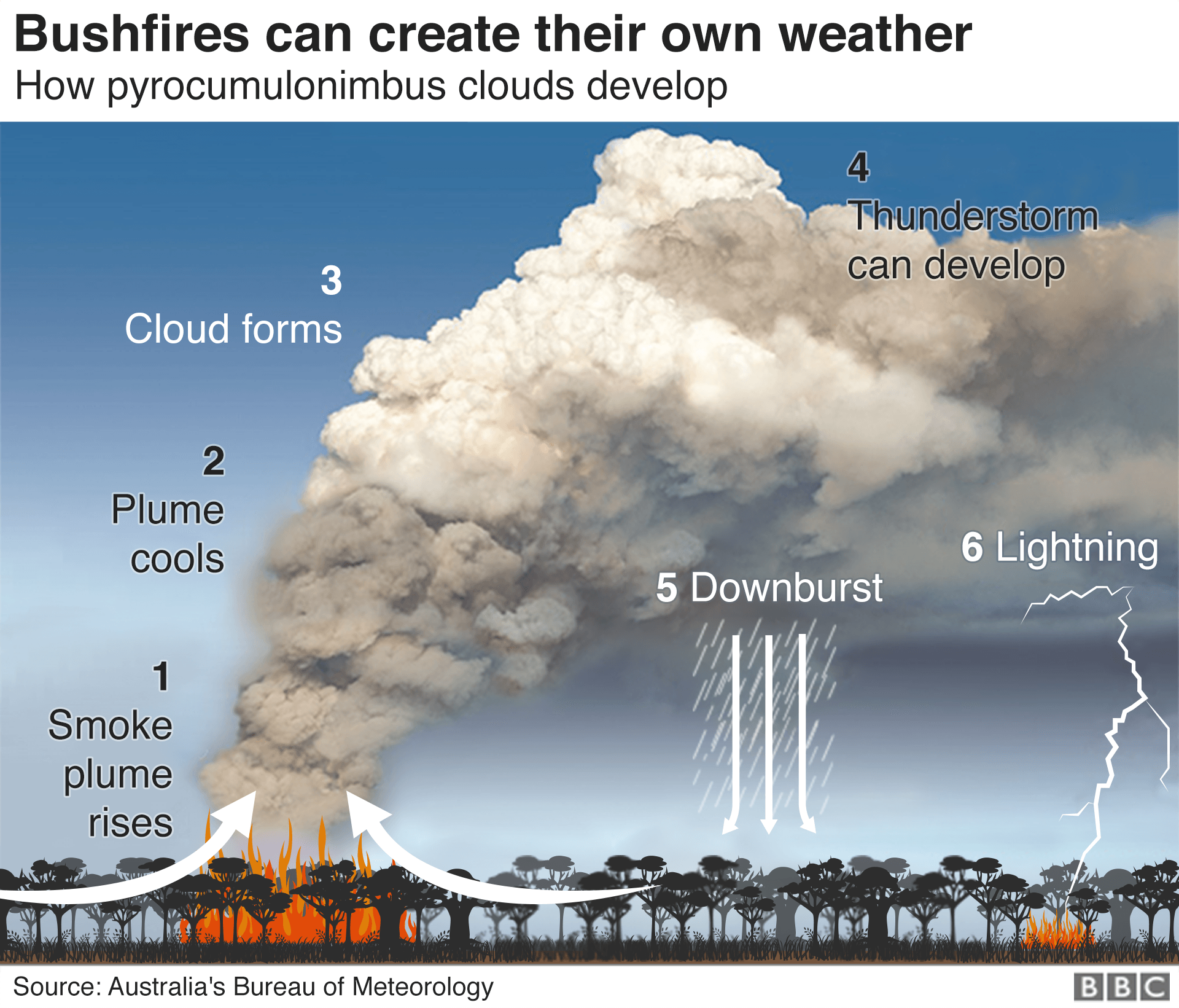
The situation in Australia appears to be different. Here’s an analysis of the 2019-2020 large-scale fires from CSIRO, Australia’s national research institution. It’s well organized and easy to read. https://www.csiro.au/en/research/natural-disasters/bushfires/2019-20-bushfires-explainer The cause of the 2019-2020 large fires was lightning, and half of Australia’s fires are caused by lightning. There’s also a mechanism where a fire itself can become a distant cause of the next lightning strike elsewhere. That’s apparently how forest fires spread in a chain reaction. Here’s an easy-to-understand illustration from the BBC. https://ichef.bbci.co.uk/news/800/cpsprodpb/1407F/production/_110374028_pyrocumulonimbus_640_eng-nc.png
Incidentally, when people generally talk about “spontaneous ignition,” the mechanism seems to be “friction between leaves.” Intuitively that sounds like it would take considerable persistence. My sense is that it’s a rare case.
Lightning and warming
Is there a relationship between lightning and warming? In 2014, a paper published in Science by researchers at UC Berkeley drew attention.
Projected increase in lightning strikes in the United States due to global warming https://science.sciencemag.org/content/346/6211/851 According to this paper, a 1 degree rise in temperature increases the probability of lightning by 12%, and the researchers projected that lightning would increase by 50% by the end of this century. The logic runs like this: water vapor in the atmosphere is like fuel for lightning, and warming is known to increase water vapor, so once ignition occurs it spreads in a chain reaction and produces a large number of lightning strikes. As lightning increases, so does NOx in the atmosphere, which is its own problem. The same researchers published work in 2011 on the correlation between rainfall, cloud lift, and lightning, and this hypothesis builds on that foundation. Updrafts increase water vapor and ice particles in the atmosphere, which causes lightning. When they checked this hypothesis against data held by the US Weather Service, lightning could be predicted with 77% accuracy. They then combined this model with 11 models predicting future climate to produce the lightning forecast through 2100 mentioned above. This link has more detail. https://news.berkeley.edu/2014/11/13/lightning-expected-to-increase-by-50-percent-with-global-warming/ This report is cited in quite a lot of places and appears to carry real authority (a Japanese-language article on this is here https://www.afpbb.com/articles/-/3031736).
Nature, on the other hand, carried a 2018 report reaching the exact opposite conclusion.
A projected decrease in lightning under climate change https://www.nature.com/articles/s41558-018-0072-6
Researchers at the University of Edinburgh, the University of Leeds, and Lancaster University compared the conventionally used CTH (Cloud-Top Height) approach with a new IFLUX (upward cloud Ice FLUX) approach that overcomes the old approach’s limitations. They found that under the IFLUX approach, lightning decreases by 15% per 1 degree rise. They also argue that predicting future lightning accurately will be difficult without a model that properly accounts for ice clouds and microscale physical phenomena.
At this point, the debate over lightning and warming remains unresolved.
Whether it spreads is the real question
Back to the main topic. “Ignition” and “catching fire” differ in whether something sets itself alight or catches fire from something else. Here are example figures for common everyday materials, showing their ignition points and flash points. https://www.hakko.co.jp/qa/qakit/html/h01080.htm
The only substance that can reach its “ignition point” at ordinary temperatures is generally “yellow phosphorus.” Phosphorus’s ignition point is 30°C, so spontaneous ignition is possible under ordinary weather conditions to begin with — it requires careful handling for exactly this reason. Aside from yellow phosphorus, almost nothing reaches spontaneous ignition at room temperature, hot or cold.
Sparks occur endlessly as a natural phenomenon, like lightning. Forest fires presumably occurred and went out on their own in prehistoric times too. So when we discuss the effects of human interference or changes in weather conditions, the focus should mainly fall on whether forest fires have become easier to spread because of some interference or change.
The real question, then, is the “flash point.” A spark alone just smolders a bit and goes out. A fire results only when it catches something else alight. How likely a large-scale fire is depends on how much the surrounding area is filled with substances likely to catch fire.
Looking at the flash points in the table above, “kerosene,” “heavy oil,” and “light oil” become more likely to catch fire as temperature rises. So maybe the real issue is whether kerosene or heavy oil exists somewhere in concentrated form, and whether fires catching from those are the problem.
The above covers common everyday substances, but I found more detailed data on flammable gases here. http://www.nohken.com/japan/technology/reference/explosive_gas.pdf
Looking at these chemical substances, it’s clear that plenty of things catch fire at room temperature. The obvious follow-up question: do these commonly exist in the natural world?
The Fire and Disaster Management Agency explains low-temperature fires as follows. http://nrifd.fdma.go.jp/public_info/faq/teionhakka/index.html
Wood’s original flash point is 200°C or higher, but continued exposure to a lower temperature (around 100°C here) evaporates its moisture, and as porosity increases, it can catch fire. This can be read as meaning that if dryness is a precondition, the change happens faster. In other words, it’s a physical explanation for the commonly stated claim that “fires during dry periods spread more easily.” Fire and Disaster Management Agency data also shows a clear correlation between humidity and the number of fires that occur.
Regarding fires involving fuel (some kind of flammable material), Australia’s national public information agency notes that “higher ambient temperatures increase fire risk by bringing conditions closer to the fuel’s flash point.” https://www.ga.gov.au/scientific-topics/community-safety/bushfire On this point, I’ve seen the argument that forest fires have become easier to spread because forest development has brought humans, and the fuel they bring with them, into the mountains, without thorough management of that fuel. A commentary from the Breakthrough Institute in Oakland was interesting on this. https://thebreakthrough.org/issues/energy/wildfire-causes
A few points from it are worth summarizing. Rising temperatures raise summer temperatures, bring snowmelt earlier, and shift winter rain to arrive later in autumn (while ending earlier); together these effects have made the high-risk fire season 50 days longer compared to 1979. The point isn’t that things burn because of rising temperatures directly, but that the overall high-risk period, including dryness, has lengthened. The sharp decline of forests in the Sierra Nevadas due to dryness, and the increased likelihood of strong winds, are not factors directly linked to recent fires. The movement of fossil fuels is the biggest risk. WUI surveys clearly show the trend of housing moving closer to forests in pursuit of a low-cost lifestyle. Forest fires, especially those of natural origin, are simply a fairly frequent natural phenomenon that would settle down to a reasonable level on its own without human interference. The argument here is that human activity encroaching on forests, combined with poor fuel management, is what raises the risk. “Why California fires have become less frequent but larger over time” is the conclusion the piece reaches.
Conclusion
At this point, claims that strongly tie forest fires to warming (“it’s warming’s fault”) objectively lack persuasiveness. A connection can’t be denied, but it falls short of being the dominant factor.
“It’s unclear” is an unsatisfying conclusion, so let me organize things by confidence level instead.
Regarding ignition
- Spontaneous ignition accounts for a low proportion of fire causes in Japan and the US. In Australia, though, spontaneous ignition is a major factor
- Among spontaneous ignitions, lightning-caused ones account for a fairly dominant share
- It’s hard to imagine warming directly increasing sparks (ignition temperatures are far removed from the scale of warming’s effects)
Regarding catching fire
- The ease with which forest fires spread is affected, to some degree, by warming (through increased porosity in wood, dead leaves, and similar material)
- In California, the dry season within the year has lengthened due to the effects of warming
- There are cases where fossil fuels brought into nature by humans make fires easier to spread
<Things that can’t be clearly stated>
- Lightning does seem related to warming, but whether the effect is positive or negative isn’t well understood at this point (either conclusion is possible depending on the climate model)
- Whether warming is the main factor increasing the ease with which forest fires spread isn’t well understood
Originally published in Japanese at https://clazytech.com/2020/10/379/. Translated with LLM assistance and reviewed before publication.